How The Fair Value Gap Works In Forex Trading

How The Fair Value Gap Works In Forex Trading

The world of forex trading is full of technical concepts, indicators, and strategies that can seem slightly intimidating when you’re starting out.

One concept that has gained significant attention in recent years, particularly among price action traders and Smart Money Concept (SMC) traders, is the fair value gap (FVG).

If you’ve spent any time researching funded trading challenges, instant funding accounts, or one-step prop firm programmes, you’ve probably come across traders discussing FVGs as part of their trading strategy.

But what exactly is a fair value gap, why does it matter, and how can forex traders use it effectively? What is a fair value gap?

A fair value gap (FVG) is a price imbalance that occurs when the market moves aggressively in one direction, leaving behind an area where very little trading activity took place.

In simple terms, the market sometimes moves so quickly that it skips over certain price levels. These skipped levels create a gap between buyers and sellers, resulting in an imbalance that many traders believe the market will eventually revisit.

The idea behind an FVG is that markets naturally seek efficiency. When an imbalance occurs, price often returns to that area before continuing its overall trend.

This creates potential trading opportunities for traders who understand how to identify and use these gaps. Understanding market efficiency

To understand FVGs, it helps to understand how markets generally operate In a balanced market, buyers and sellers interact continuously at various price levels. Price moves smoothly because transactions occur across a wide range of prices.

However, when significant buying or selling pressure enters the market, price can surge rapidly. This rapid movement means some price levels receive very little trading volume compared to surrounding areas. These inefficient areas become FVGs. How to identify a fair value gap

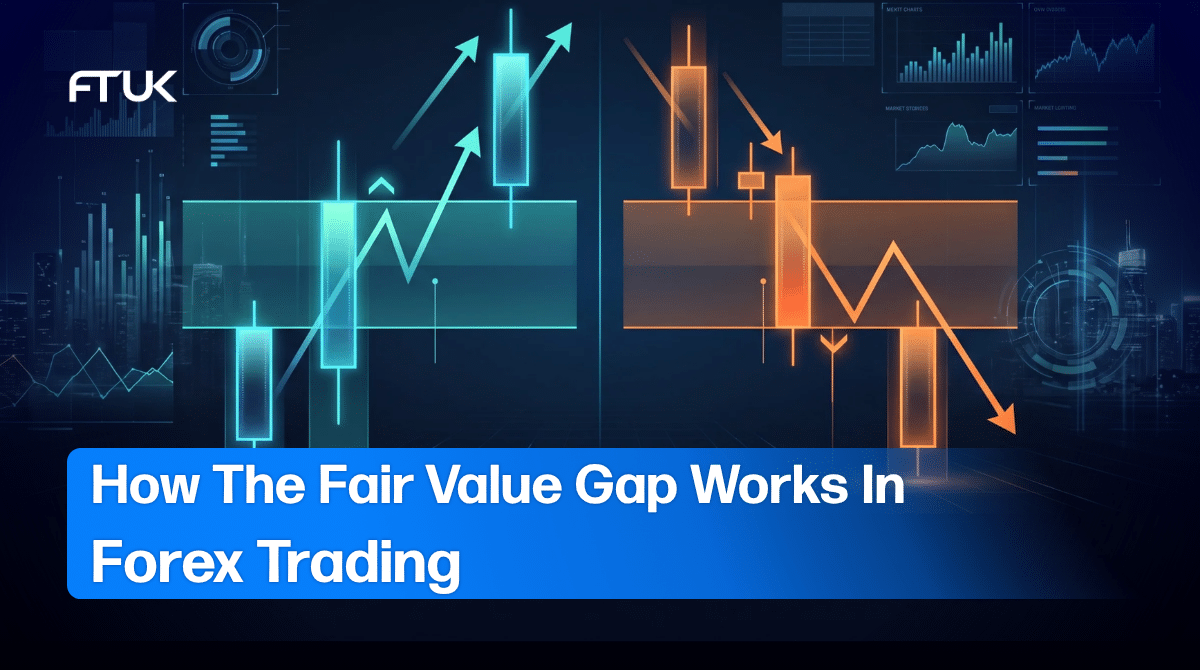
Most traders identify FVGs using a simple three-candle formation Bullish fair value gap

A bullish FVG forms when

The first candle closes

The second candle makes a strong upward move

The third candle continues higher

The key feature is that the low of the third candle remains above the high of the first candle. This leaves an untraded area between those two levels. Bearish fair value gap

A bearish FVG forms when

The first candle closes

The second candle moves strongly downward

The third candle continues lower

The high of the third candle remains below the low of the first candle. Again, this creates an imbalance zone where little trading occurred.

Many charting platforms now offer indicators that automatically highlight FVGs, but understanding how to spot them manually remains an important skill. Why do fair value gaps matter?

FVGs matter because they represent areas where the market may later return. Institutional traders, hedge funds, and large market participants often execute substantial orders that contribute to these rapid price movements.

Some traders believe that when these imbalances occur, the market often revisits them to facilitate additional order flow before continuing its broader direction.

While no trading concept works 100 per cent of the time, FVGs can provide useful areas for

Potential trade entries

Stop-loss placement

Profit targets

Trend continuation analysis

Market structure confirmation

Many traders incorporate FVGs into a wider trading framework rather than using them as standalone signals. Fair value gaps and smart money concepts

FVGs became particularly popular through Smart Money Concepts trading methodologies. SMC traders focus on understanding how larger market participants may influence price movements.

Rather than relying heavily on traditional indicators, they analyse price structure, liquidity, order flow concepts, and market inefficiencies. Within this framework, FVGs are viewed as evidence of institutional activity creating temporary imbalances.

Whether you fully subscribe to Smart Money Concepts or not, FVGs can still serve as useful technical reference points for understanding market behaviour. Using fair value gaps in forex trading

There are several ways traders use FVGs within their strategies. Trading retracements

One common approach involves waiting for price to retrace into an FVG after a strong directional move.

For example

EUR/USD rallies strongly

A bullish FVG forms

Price pulls back into the gap

Traders look for confirmation signals

A long position is considered

The theory is that the gap may act as a support area before the trend resumes. Trend continuation entries

Many traders use FVGs to enter existing trends rather than trying to predict reversals. This can help align trades with market momentum while obtaining a more favourable entry price. Combining with market structure

Some of the highest-quality FVG setups occur when the gap aligns with broader market structure.

For example

Higher highs and higher lows in an uptrend

A bullish FVG forms

Price retraces into the gap

A bullish reaction develops

When multiple factors align, traders often view the setup as having stronger probability. Common mistakes when trading fair value gaps

Like any trading concept, FVGs can be misused. Trading every gap

Not every FVG will produce a profitable setup. Markets create numerous gaps every day, particularly on lower timeframes. Selecting higher-quality gaps within strong trends is often more effective than trading every imbalance that appears. Ignoring market context

An FVG should never be viewed in isolation. Economic news market sentiment, liquidity conditions, and overall trend direction all matter.

A bullish FVG appearing directly before a major interest rate announcement may not behave as expected. Poor risk management

Even the most attractive setup can fail. Successful traders understand that FVGs offer possibilities, not guarantees. Risk management remains essential.

This means

Using stop losses

Managing position sizes

Maintaining favourable risk-to-reward ratios

Avoiding emotional decision-making

Which timeframes work best for fair value gaps?

FVGs can appear on virtually any timeframe. However, many experienced traders prefer higher timeframes because they tend to filter out market noise.

Popular choices include

One hour charts

Four hour charts

Daily charts

Higher-timeframe FVGs often carry greater significance because they reflect larger market movements.

That said, day traders frequently use FVGs on

Five minute charts

15 minute charts

30 minute charts

The best timeframe depends on your trading style and objectives. Fair value gaps and prop firm trading

For traders pursuing funded accounts, FVGs can be particularly useful. Most modern prop firms evaluate traders based on consistency, risk management, and profitability.

Whether you’re participating in a traditional challenge model, a one-step evaluation, or an instant funding programme, maintaining disciplined execution is critical. Many successful funded traders use FVGs because the concept naturally encourages patience.

Instead of chasing price after a strong move, traders wait for the market to return to an area of interest before considering an entry. This can help reduce impulsive trading and improve overall trade selection.

For traders attempting to pass funded challenges, fewer high-quality trades often outperform a large number of lower-quality setups. Fair value gaps versus traditional support and resistance

A common question is whether FVGs are simply another form of support and resistance There is certainly some overlap. Traditional support and resistance focus on historical turning points where price reacted previously.

FVGs focus on market inefficiencies created by aggressive directional movement. In practice, the two concepts often work well together. For example, a bullish FVG that overlaps with a key support level may attract additional attention from traders.

The more reasons traders have to monitor a particular area, the more significant that area may become. Can fair value gaps be automated?

Many trading platforms now offer indicators that automatically identify FVGs. These tools can save time and help traders spot opportunities more efficiently.

However, automation has limitations. Indicators cannot fully understand market context, trend quality, economic events, or trader psychology.

For this reason, many experienced traders use FVG indicators as a visual aid rather than relying on them exclusively for trade decisions. Are fair value gaps reliable?

The honest answer is that FVGs are neither magic nor meaningless. Like any technical analysis tool, they work best when combined with broader market understanding.

FVGs can provide useful insight into areas where price may revisit, but they should form only one component of a complete trading plan.

Successful traders typically combine FVG analysis with

Market structure

Trend analysis

Risk management

Economic awareness

Trade psychology

No strategy wins every trade. The goal is not perfection but developing a repeatable process with a positive long-term expectancy. FVGs: A useful tool for new and experienced traders

FVGs have become one of the most discussed concepts in modern forex trading, particularly among traders using price action and Smart Money Concepts methodologies.

At their core, FVGs represent market inefficiencies created by rapid price movement. Many traders monitor these areas because markets frequently revisit them before continuing their broader direction.

For beginners, FVGs offer a practical way to understand market behaviour beyond traditional indicators. For more experienced traders, they can provide valuable entry, exit, and risk management opportunities.

Whether you’re trading a personal account, working towards a funded account, or looking for a pay after you pass a prop firm challenge, the key remains the same: combine technical tools such as FVGs with disciplined risk management and consistent execution.

The traders who succeed over the long term are rarely those chasing every market move. More often, they are the traders who wait patiently for high-quality opportunities and execute their plans with discipline.
What Is The 3-5-7 Rule In Trading?

What Is The 3-5-7 Rule In Trading?

In financial trading, success is not determined by the peaks of your strategy but the return you make at the end of the day, and the way to sof instant funding is not only to know when to enter the market but also when to exit.

This is where risk management becomes so important, but given the complex intricacies of investing, knowing where to set stop-loss orders, drawdown limits and how to diversify your portfolio can be quite difficult to completely grasp at first.

The best way to develop your risk management skills is to trade, network with other investors and learn the forex market, but there are some simple rules of thumb you can use to get started.

The 3-5-7 Rule is a position-sizing concept that can help you avoid a strategy so risky it requires almost impossible luck to succeed, whilst also not being so conservative that you do not make a return at all.

To explain why it works, we need to break down all three numbers before we examine how you can apply these principles to your trading strategy to maximise consistent returns.

How Does The 3-5-7 Rule Work?

The 3-5-7 rule is a simple, scalable risk management strategy that is ideal for traders who are just starting out, whilst also providing a foundation to build more tailored risk management strategies in the future.

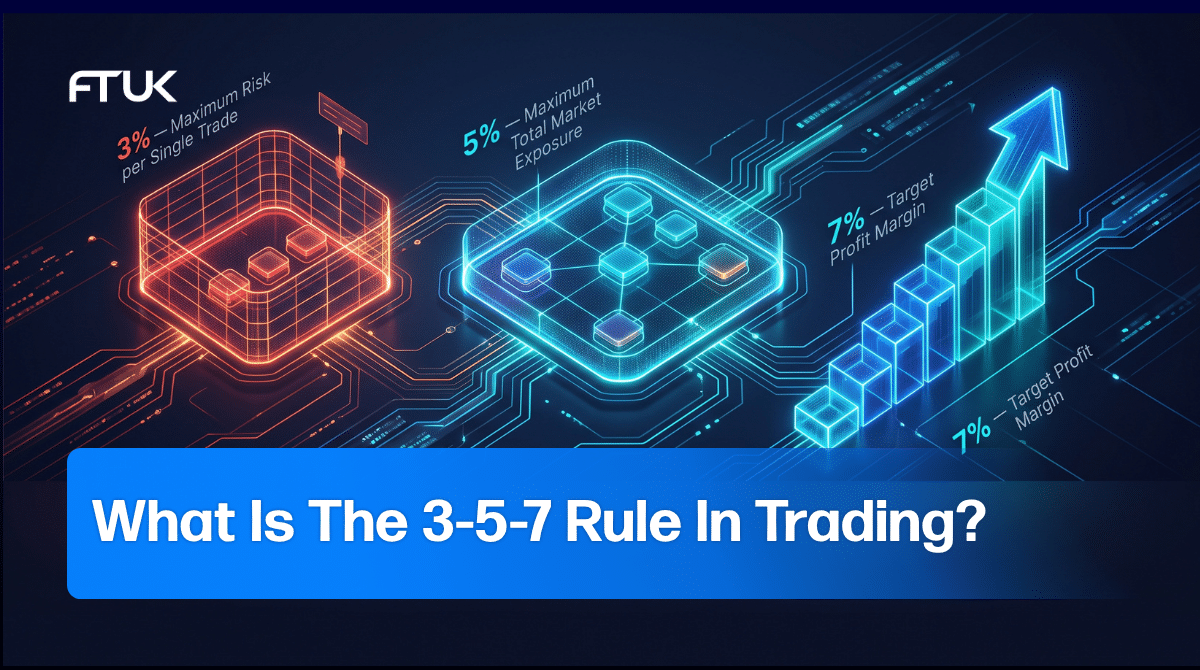
At its core, it is made up of just three simple rules

No more than three per cent of your capital should be at risk during a single trade.

No more than five per cent of your total capital should be exposed to the market at any time.

Winning trades should make a seven per cent profit.

These are easy to follow, easy to measure and allow for quick responses and decisions to be made during particularly volatile periods in the market.

Why Does The 3-5-7 Rule Use These Specific Percentages?

Whilst part of the appeal of the 3-5-7 rule comes from how much we love those three numbers as the first three odd-numbered prime numbers and variations of the 3-5-7 pattern occur in other walks of life, there is a specific reason why each number is chosen.

Why Three Per Cent Risk?

A successful trading portfolio should be relatively conservative, as no individual trade nor string of bad luck should have the power to wipe you entirely.

However, given the costs of maintaining trading positions, a portfolio cannot be so conservative as to make profits impossible to obtain.

For example, if you have a trading capital of $100,000, you should avoid risking more than a $3000 loss on a single trade.

It causes you to focus on your position sizing and stop-loss orders, allowing you to get out quickly if the market turns rather than hoping for a turnaround that may never come.

Why Five Per Cent Exposure?

The five per cent part of the rule concerns exposed capital and how much you actively have at risk. As many positions can affect each other, this helps to minimise the losses you take and encourages diversification.

If the three per cent rule involves risk exposure over a single trade, the five per cent rule affects your whole portfolio, and stops you from taking a huge number of trades that could collectively wipe you out, even if each one is relatively safe from a risk management perspective.

It helps you see the bigger picture and adjust your portfolio if you do have more losses than gains.

Why Seven Per Cent Profit?

The seven per cent rule for profit margins reflects the market reality that a lot of trades will not necessarily be successful, but as long as your profits are large enough, they can wipe out your losses and then some.

You do not need to win every trade, something that is actively impossible. However, when you do succeed, you often do so in ways that help you claw your way back into profitability.

It also avoids being too cautious to make money; given fees and interest, a small enough gain can lose you money. Instead of exiting winning trades early, let them run long enough to maximise their earning potential.

How Do You Implement The 3-5-7 Rule In Your Trading Plan?

Assess your existing strategy.

Trade smaller positions than usual.

Set clear, disciplined stop-loss orders.

Keep a trading journal that assesses your position entries and exits.

Review your trades and how you react to gains and losses.

Consider scaling your risk when trades move in your favour.

Think about existing market conditions.

Adjust for volatility.

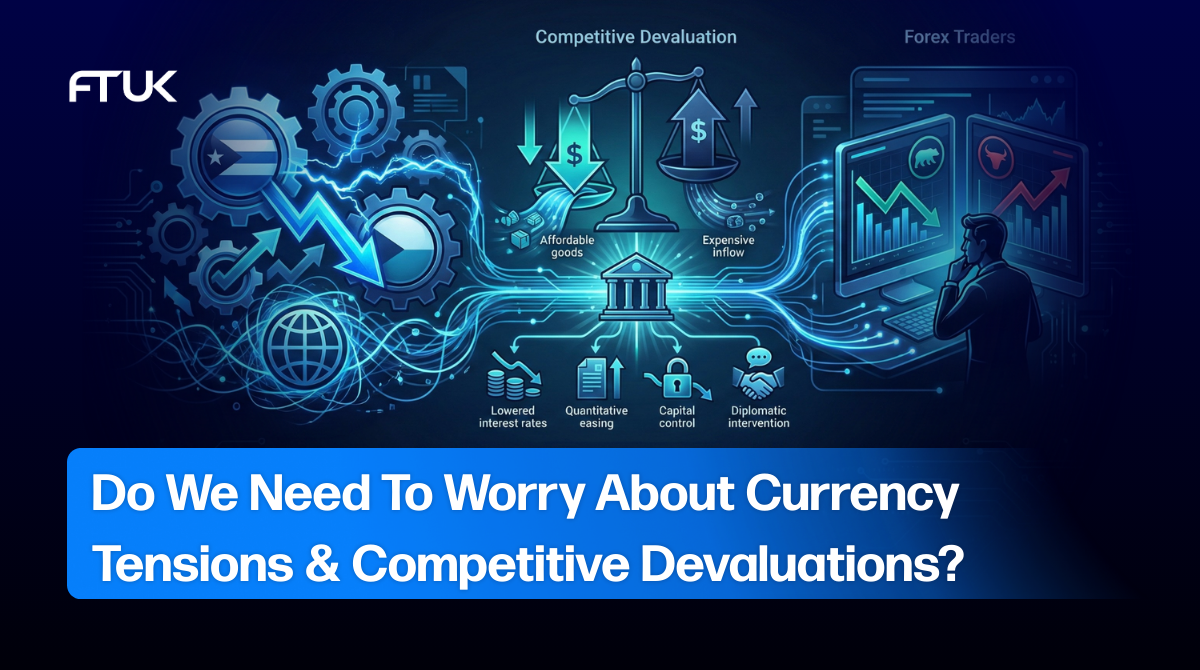
Do We Need To Worry About Currency Tensions & Competitive Devaluations?

Do We Need To Worry About Currency Tensions & Competitive Devaluations?

It is often said that chaos breeds opportunity, and the nature of currency markets means that major news events, stories and chaos can havinstant forex funding

In particular, currency tensions and competitive devaluations have hit the news lately as political tensions and turmoil have rather directly impacted forex for deliberate reasons bordering on outright strategic.

Many of these decisions happen on a much higher level than traders or investors, but by understanding the general state of affairs and the relationships between the nations that take part in competitive devaluations and currency wars, you can know when to invest and when to take a step back.

What Are Currency Tensions?

Currency tensions, sometimes known by the far more hostile and aggressive term currency wars, are where monetary policy is designed to improve the competitiveness of one nation at the expense of others they are paired with.

The intention is to make export products cheaper, in turn making a country more appealing to trade with, but this, conversely, makes imports more expensive for consumers in a nation.

This can be fine for markets where a nation has domestic alternatives that reduce the need for imports, but it can have the consequence of increasing the cost of living and lowering productivity if a nation is reliant on imported supplies such as equipment and some raw materials.

It is often caused through intentional or unintentional devaluation of a currency through the reduction of interest rates, quantitative easing (a way to add liquidity to a market wherein a central bank buys treasury bonds or other similar assets in bulk) and other protectionist measures.

At its most extreme, it can lead to outright trade tariffs, which contrary to some media reports, are paid by customers importing products, not nations exporting, and can often lead to reciprocal tariffs that cause products to become more expensive in real terms.

What Is Competitive Devaluation?

Competitive devaluation is similar to a currency war but involves a more specific set of tactics and is typically focused on a narrowly focused economic and trade policy.

Whilst currency wars can happen for a variety of reasons competitive devaluation is specifically focused on making exports much cheaper, increasing sales and reducing trade deficits by artificially focusing on exports over imports.

Choosing to deliberately devalue a nation’s currency is a very complex decision to make, often reliant on using foreign investment through purchasing products you export to stimulate economic growth, which can cause trade tensions and increased inflation.

How Do Countries Deliberately Devalue Currencies?

Quantitative Easing: This is a form of central bank intervention where a sovereign bank buys long-term securities to increase the supply of cash, which in turn encourages investment and cash. It invariably leads to inflation but can be necessary in a currency crisis.

Lowered Interest Rates: If interest rates are lower, there is less incentive to invest in a nation from outside, but this, in turn, can make it easier to lend money to people domestically at competitive rates.

Intervention Buying: A nation may purchase assets to lower the value of currency but support prices and encourage stability.

Controlling Flows Of Capital: A more direct form of intervention, a central bank can explicitly link the amount of money that can flow out of or into the country, often primarily focused on avoiding a monetary flight to security.

Diplomatic Interventions: As a lot of value in the forex market is based on the sentiment of investors, telling the right story will often affect the market. Central banks try to avoid this, but it can be difficult to stop when many investors will invest based on market sentiment.

Are They Cause For Concern For Forex Traders?

In general, a sovereign country devaluing their currency is bad for investors who have gone long on said currency, as the currency pair will inevitably drop as a response. By contrast, if you try to short a particular currency, you are set to gain as a result.

This was infamously the case during Black Wednesday, one of the most impactful cases of a currency devaluation (albeit not undertaken deliberately), where George Soros and Stanley Druckenmiller intentionally bet against the British pound, forcing it out of the fixed exchange rate mechanism, and ultimately forcing it out of the single European currency.

Ultimately, competitive devaluation creates a beggar-thy-neighbour situation where a single country benefits in a way that negatively affects other trade partners.

The Rise Of AI Economies And Their Impact On Forex Trading

The Rise Of AI Economies And Their Impact On Forex Trading

For better and for worse, AI has had a significant effect on forex trading over the past few years, and every trader, from the smallest ininstant forex funding, has been forced to react to its particularly unusual effects.

Trading has been affected by algorithmic trading practices for decades, using systems that range from exceptionally simple and necessary orders to sophisticated and often opaque strategies that are difficult for the creators to explain, let alone many traders.

However, this is only one way in which AI’s myriad tendrils have affected the market, as the sheer footprint and scale of AI tools and the rather fragile nature of its growth have the ability to affect forex not only within the market itself, but in the same way the dotcom bubble did.

Exactly what its overall effect will be is almost impossible to tell, from a small net boost in GDP to a radical revolution in how we live our lives and interact with the stock market, to a borderline economic apocalypse.

To explain why we need to cover a lot of ground, including explaining what AI is, how it directly and indirectly affects the forex market, and what individual traders can do to prepare for the boom or the bust.

What Is AI In The Context Of Economics?

It is actually a much more difficult question than one might expect to explain AI, as there currently exist two increasingly separate concepts which both happen to be called AI.

At the same time, AI is

A collection of technologies and programming schools of thought which allow for computer programs to simulate aspects of human intelligence and complete tasks that typically require humans to complete.

A technology hype bubble focused on a narrative that AI will integrate into every part of people’s lives and replace a significant number of jobs and lives in ways that sound borderline alchemical.

In the context of how AI will affect forex traders, the focus is much more on the second definition of AI, which consists of large language models which create content, communicate with users and use unfathomably large swathes of training to approximate and produce an answer which looks correct.

This includes tools such as OpenAI’s ChatGPT, Google Gemini, Microsoft Copilot and countless others, often described anthropomorphically as AI ageor agentic AI

They work like highly sophisticated predictive text generators; they use vast swathes of training data and previous interactions to guess the right answer, which to a user would give the impression of conversation, generated content and insight.

Depending on which analysis you choose to follow, AI is a potentially fundamentally transformative series of tools that will forever change the Mechanical Turk, a machine powered by the unpaid or barely-paid work of others.

How Did AI Become So Important For Traders?

Artificial intelligence has existed in theoretical form since Alan Turing, and there have been cycles of development and winter for AI since at least the 1970s when computers became powerful enough and cheap enough for businesses to use.

Algorithmic trading has been used for decades, and AI deep learning tools have been developed to undertake increasingly complex tasks since tsuccess of AlphaGo being a watershed moment.

However, it entered the popular consciousness in late 2022 and early 2023 with the public release of ChatGPT

Whilst far from the first large language model (LLM), ChatGPT was the first to capture the public imagination and led to a swathe of haste integrations of “AI functions” with varying degrees of success, usability and ethics.

However, even if you do not use any AI tools to trade yourself, because others are, it can have a huge effect on trading, and both its irrational exuberance phase and the potential bursting of the AI bubble will affect traders in forex, even if they are not directly trading overvalued AI company stocks.

How Does AI Impact Forex Trading Directly?

The exact impact of AI on forex is difficult to truly quantify, but there are both direct and indirect effects on the market, with the former defined as how AI will affect trading decisions, the development of trading plans and how people and non-human agents engage with the market.

As noted before, the underlying technology behind “AI” has been used a lot since the 1980s in forms such as algorithmic trading and high-frequency trading, as well as in how a trading plan is developed and executed.

As computers can react much faster than people, something that is even more true thanks to the powerful computers and data centres necessary to run AI services.

In particular, there are several potential shifts in trading approach caused by the rise of AI tools

Market analysis has become more sophisticated, with news, market sentiment, price data and interpreting the noise of the market to explore opportunities or avoid potential risks.

The development of short-term predictive analytics strategies that are able to detect patterns in currencies in the short term and develop intra-day strategies.

Even faster automated execution, allowing for better adjusting of positions or initiating trades based on a trading plan, but more quickly executed than a human would be able to.

Enhanced risk management systems, which allow for anomalies in the market to be detected sooner and stop-loss levels to be adjusted.

All of these potential benefits must be tempered with the risks that come with AI integration, both from a technical standpoint and from a philosophical mindset.

AI tools are infamous for making errors, relying heavily on past data, making improper analyses based on opaque interpretations of markeknown as hallucinations

What compounds these issues is that AI tools often cultivate learned helplessness; part of the process of becoming a skilled forex trader is to develop and adjust your trading plan and learn from every trade, both successful and unsuccessful.

AI systems take that away, and if something goes wrong, it can lead to extremely costly mistakes that are difficult to fix because it is difficult to ascertain the logic that led to this.

This is known as the “black box trap” and something that traders who rely on AI in ways that transcend their understanding risk falling into.

This can have a wider effect on how traders will react to market instability and volatility, and create a different type of trading psychology.

How Does AI Impact Forex Trading Indirectly?

However, the biggest effects found with forex trading are less focused on their direct effects on the forex market and more on how AI impacts the variables which affect currency prices and pairs.

The economic effects of AI in the long run are extremely difficult to predict, and this has led to some truly wild predictions for the technology.

Anything from a global increase to the world’s GDP of $7tn to much more conservative gains and even dramatic losses has all been suggested, and it all depends on how widely the tools are used, how efficiently they can be scaled and whether there is a potential return on investment.

The talk of an AI bubble has grown louder in recent months due to the irrational exuberance of the market pushing AI-related tech companies into significantly overblown valuations.

This is particularly the case for the so-called Magnificent Seven, the seven tech companies that were such a big driver of the United States’ economic growth and thus the value of the dollar

These are

Alphabet – The parent company of Google.

Amazon – The world’s biggest ecommerce company, which is a key part of AI infrastructure through Amazon Web Services (AWS).

Apple – Apple’s work with the Siri voice assistant was an early example of AI integration.

Meta – Whilst Meta’s metaverse ambitions have faltered, they have worked to integrate AI into platforms such as Facebook.

Microsoft – The creator of Windows has tried to add Copilot AI functionality into every nook and cranny of the system, as well as invest heavily in OpenAI and other AI companies.

NVIDIA – The world’s biggest producer of computer graphics cards has made a hard pivot towards AI, even describing itself as an AI company.

Tesla – Besides the development of xAI and Grok, Tesla has pivoted towards developing robots instead of cars, as well as attempting to get their self-driving autonomous vehicle technology onto the road.

These companies are either heavily invested in AI or provide the tools and technologies necessary to keep the system working. They have also heavily invested in each other, creating the potential for a massive financial collapse should the AI bubble suddenly burst.

This particularly affects countries which have heavy investments in AI. Whilst the US dollar is the most obvious country affected, with a poflights to security towards the Euro, the yen, the Swiss franc and even to gold, it can affect countries which produce chips and components required to power AI data centres.

Finally, if AI leads to mass layoffs, that can have a huge effect on economic reports, which often causes a downturn in currencies.

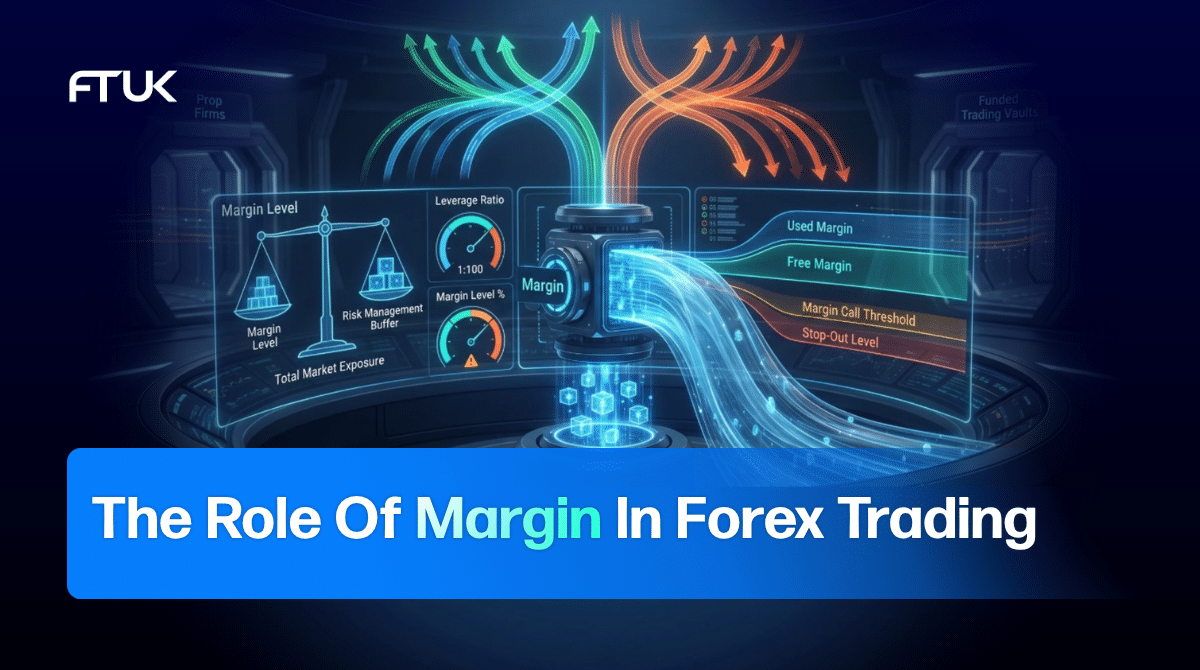
The Role Of Margin In Forex Trading

The Role Of Margin In Forex Trading

Forex trading offers opportunities that attract traders from all levels of experience. The market is open nearly 24 hours a day, liquidity is extremely high, and modern platforms make it possible to participate with relatively small amounts of capital.

One of the key features that makes this possible is margin. Margin is fundamental to how the forex market operates, yet it is often misunderstood by beginners. Some traders view it simply as a way to trade larger positions.

In reality, margin is also a risk management mechanism that allows brokers and prop firms to facilitate leveraged trading while maintaining market stability.

Understanding how margin works, and how to manage it properly, is essential for anyone who wants to trade forex responsibly and consistenfunded trading account through a prop trading firm.

This guide explains the role of margin in forex trading, how it interacts with leverage, and why it matters for both beginner and experienced traders. What is margin in forex trading?

Margin is the amount of capital required to open and maintain a leveraged trading position Rather than paying the full value of a trade upfront, a trader deposits a fraction of the total position size.

This deposit acts as collateral that allows the broker or prop firm to extend leverage. For example

A trader opens a $100,000 forex position

The margin requirement is one per cent

The trader must deposit $1,000 as margin

The trader controls a much larger position than the capital committed, which magnifies both potential profits and potential losses.

Margin should not be confused with a trading fee. It is not a cost but rather a portion of funds set aside to support open trades. Margin vs leverage: understanding the relationship

Margin and leverage are closely related concepts Leverage describes how much larger a position is compared to the capital used to open it. If a broker offers 1:100 leverage, the margin requirement is typically one per cent of the trade size.

This means

$100,000 trade requires $1,000 margin

$10,000 trade requires $100 margin

Higher leverage reduces the margin required per trade, allowing traders to control larger positions with less capital. However, this also increases risk, which is why disciplined margin management is crucial. Why margin exists in forex markets

Margin serves several important functions in the forex ecosystem. 1. It enables capital efficiency

Forex is a market where price movements are typically measured in fractions of a per cent. Without leverage and margin, traders would need extremely large capital reserves to generate meaningful returns.

Margin allows traders to participate in the market without needing institutional-scale capital. 2. It protects brokers and prop firms

Margin acts as a risk buffer. If a trade moves against a trader, the broker or prop firm uses the margin deposit to cover potential losses. This ensures that trading accounts cannot accumulate unlimited negative balances under normal circumstances. 3. It supports market liquidity

By allowing participants to trade larger positions, margin contributes to the deep liquidity that makes forex markets so efficient. Types of margin forex traders should understand

To manage risk effectively, traders need to understand several different margin-related terms used on trading platforms.

Used margin

Used margin is the total amount of capital currently locked in open positions.

If you open multiple trades, each position requires margin. The combined total becomes your used margin.

Free margin

Free margin is the capital still available to open new positions.

It is calculated as

Account equity – used margin

Free margin is important because it determines how much additional exposure a trader can take on.

Margin level

Margin level measures the health of a trading account.

It is usually expressed as a percentage

Margin level = (equity / used margin) × 100

A higher margin level indicates more available capital relative to open trades. When margin levels fall too low, brokers may restrict trading activity.

Margin call

A margin call occurs when account equity falls below a specified threshold.

When this happens, the broker or platform may require traders to

Deposit additional funds

Close positions

Reduce exposure

Stop-out level

If losses continue to grow and margin levels fall further, the platform may automatically close trades to prevent the account balance from going negative. This is known as the stop-out level. How margin amplifies profits and losses

Margin is powerful because it allows traders to control larger positions. But that same power cuts both ways.

Consider a simplified example

Scenario without leverage

Trade size: $10,000

Market move: one per cent

Profit/loss: $100

Scenario with 1:100 leverage

Margin required: $100

Trade size: $10,000

Market move: one per cent

Profit/Loss: $100

In this case, a one per cent market move equals a 100 per cent return on the margin used. But if the market moves against the trader by one per cent, the loss is also $100, which could wipe out the margin entirely.

This is why professional traders focus heavily on position sizing and risk management, not just leverage. Margin management: a key skill for forex traders

Many beginners fail not because of poor trade ideas, but because of poor margin management.

Experienced traders typically follow several key principles

Avoid over-leveraging

Just because high leverage is available does not mean it should always be used. Many successful traders use only a small portion of available leverage to maintain flexibility.

Keep margin levels healthy

Maintaining a comfortable margin level reduces the risk of forced liquidation during temporary market volatility. Professional traders often aim for margin levels well above minimum thresholds.

Use stop losses

Stop losses prevent trades from consuming excessive margin if the market moves against the position. Without them, even small market swings can rapidly escalate losses.

Manage total exposure

Opening multiple correlated trades can dramatically increase margin usage.

For example

EUR/USD long

GBP/USD long

AUD/USD long

These positions all depend heavily on US dollar movement, effectively multiplying risk. How do you manage margin in forex prop firm trading?

Margin management becomes even more important when trading through a prop firm.

Many prop firms offer traders access to larger accounts through

Evaluation programs (one-step or two-step challenges)

Instant funding models

Profit-sharing agreements

These models allow traders to scale their capital significantly compared to trading with personal funds.

However, prop firms also enforce strict risk rules, including

Maximum daily drawdown

Maximum overall drawdown

Position size limits

Leverage caps

Because margin determines position size and exposure, poor margin management can lead to rule violations, even if a trade idea itself is sound. Traders who succeed in prop firm environments tend to treat margin as a risk allocation tool, not simply a way to trade bigger. Margin and account growth

Understanding margin properly can help traders scale their accounts more sustainably. When traders increase their account balance, margin requirements become easier to manage.

As capital grows, traders can maintain the same trade sizes while reducing overall risk. This is why many funded traders aim to scale accounts gradually, rather than dramatically increasing leverage after profitable periods. Common margin mistakes beginner forex traders make

Many new traders encounter margin problems early in their trading journey. The most common mistakes include

Trading too many positions

Opening multiple trades simultaneously can quickly consume available margin and reduce flexibility.

Ignoring correlated risk

Traders sometimes believe they are diversified when they are actually taking multiple versions of the same trade.

Using maximum leverage

High leverage may seem attractive but leaves very little room for normal market fluctuations .

Not monitoring margin level

Some traders focus only on profit and loss while ignoring their margin level, until a margin call occurs.

Building awareness of these risks early can prevent unnecessary losses. Why prop firms emphasise risk control

Prop trading firms are not simply looking for traders who can generate profits. They are looking for traders who can manage risk consistently.

From a firm’s perspective, margin discipline demonstrates several important qualities

Strategic thinking

Capital preservation

Professional risk management

Emotional control

Traders who manage margin effectively and develop a good trading mindset are far more likely to succeed when given access to larger funded accounts.

Margin is one of the most important, and most misunderstood, concepts in forex trading. It enables traders to participate in the market with relatively small capital, but it also introduces significant risk when used improperly.

Rather than viewing margin purely as a way to increase trade size, successful traders treat it as part of a broader risk management framework. They carefully monitor margin levels, control leverage, and ensure that no single trade can jeopardise their entire account.

For traders pursuing funded opportunities with prop firms, mastering margin management becomes even more critical. Firms look for disciplined traders who understand how to balance opportunity with risk, protecting capital while steadily building profits.

In the long run, consistent success in forex trading is rarely about taking the biggest positions. It is about managing exposure intelligently, preserving capital during difficult periods, and using tools like margin strategically.

For traders who learn to respect and control margin, it becomes not a danger, but a powerful ally in building a sustainable trading career.

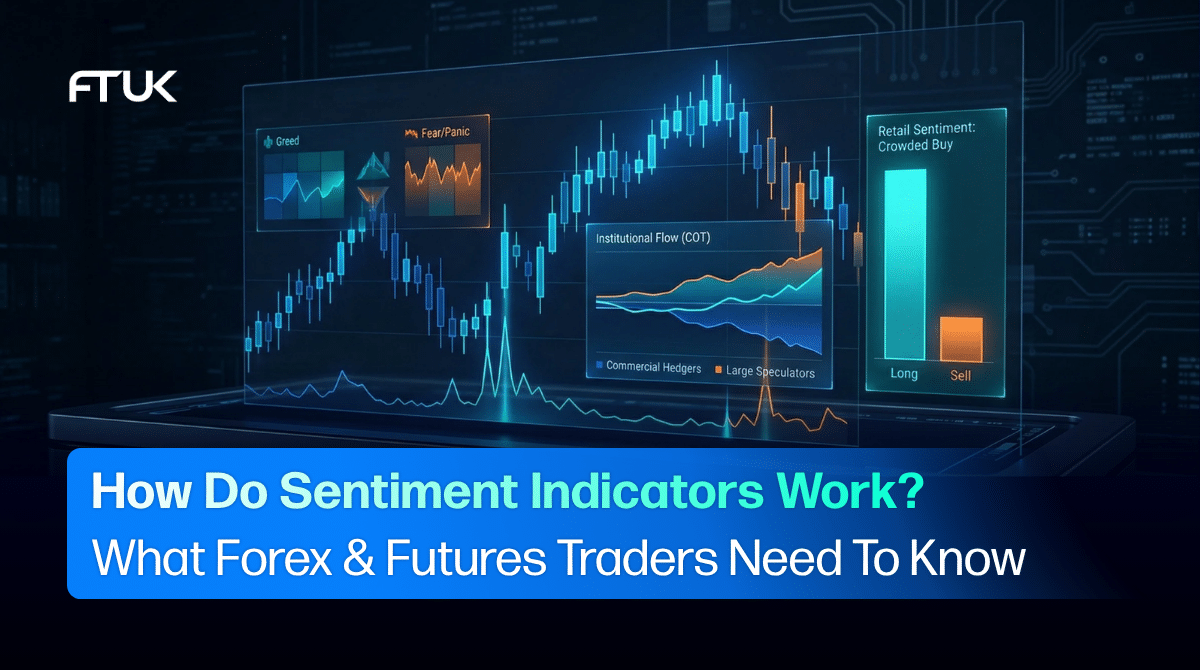
How Do Sentiment Indicators Work? What Forex & Futures Traders Need To Know

How Do Sentiment Indicators Work? What Forex & Futures Traders Need To Know

Successful trading is not just about interpreting price patterns. At its core, every market move reflects behaviour driven by deep-seated and instinctive human emotions: fear, greed, pride, doubt, and panic.

Sentiment indicators attempt to quantify these emotions and translate them into actionable insights. Sentiment analysis offers a powerful way to understand how the majority of market participants are positioned, and whether that positioning creates opportunity or risk.

Here, we explain what sentiment indicators are, how they work, the most common types used in forex and futures trading … and how disciplined traders use them within a structured trading plan. What are sentiment indicators?

Sentiment indicators measure market psychology rather than price or volume alone. They aim to show whether traders are broadly bullish, bearish, or neutral on a given market.

Unlike technical indicators such as moving averages or RSI, which analyse price behaviour, sentiment indicators focus on positioning, expectations, and emotional extremes. They answer questions like

Are most traders currently long or short?

Is optimism becoming excessive?

Are traders fearful or complacent?

Is the market crowded in one direction?

In many cases, sentiment indicators are most useful as contrarian tools, highlighting moments when the majority may be wrong and vulnerable to a reversal. Why does sentiment matter in forex and futures markets?

Forex and futures markets are highly liquid, leveraged, and sensitive to news. Because of this, trader behaviour often becomes self-reinforcing in the short term and overextended in the medium term.

Key reasons sentiment is especially relevant include

Retail traders tend to cluster around obvious levels

Leverage magnifies emotional decision-making

News and economic releases create rapid mood shifts

Large institutions exploit crowded positioning

Understanding sentiment helps traders avoid emotional traps and recognise when a move may be nearing exhaustion. How do sentiment indicators collect their data?

Sentiment indicators rely on data sourced from traders, brokers, exchanges, or surveys. The most common inputs include

Open long vs short positions

Futures commitment reports

Options positioning

Volatility measures

Survey-based confidence readings

The accuracy of a sentiment indicator depends heavily on who the data represents: retail traders, institutional traders, or the entire market. Retail positioning indicators (long vs short ratios)

One of the most widely used sentiment tools in forex trading is retail positioning data. This shows the percentage of traders who are long versus short in a particular currency pair.

For example

75 per cent of traders long EUR/USD

25 per cent of traders short EUR/USD

This type of indicator works because retail traders as a group tend to be net losers, often

Chasing price after extended moves

Holding losing trades too long

Trading emotionally around news

As a result, professional traders often view extreme retail sentiment as a contrarian signal. How do traders use retail positioning data?

Majority long: bearish bias

Majority short: bullish bias

Extreme imbalance: higher reversal risk

Retail sentiment is particularly useful when aligned with technical resistance or support. Commitment of Traders reports

The Commitment of Traders (COT) report is one of the most respected sentiment tools in futures trading. Published weekly, it shows how different categories of traders are positioned in futures markets.

COT data breaks participants into groups such as

Commercial hedgers

Large speculators (institutions, hedge funds)

Small speculators (retail)

Why does COT data matter in forex/futures trading?

Commercial traders are often considered “smart money”

Large speculators drive medium-term trends

Extreme positioning can signal trend maturity

COT data is not a short-term timing tool. Instead, it helps traders understand broader sentiment cycles and structural bias over weeks or months. Volatility-based sentiment indicators

Volatility itself is a form of sentiment High volatility typically reflects fear and uncertainty, while low volatility often signals complacency.

Common volatility-based sentiment tools include

VIX (for equity-linked futures)

Implied volatility in options markets

Average True Range (ATR) trends

How do traders interpret volatility sentiment?

Rising volatility: fear increasing

Extremely low volatility: risk of sudden expansion

Volatility spikes: potential panic or capitulation

In futures trading, volatility sentiment is especially important for risk management, position sizing, and avoiding over-trading during unstable conditions. Options Market sentiment (put/call ratios)

In some markets, traders analyse sentiment using options positioning, particularly the ratio of puts (bearish bets) to calls (bullish bets).

A high put/call ratio may indicate

Fear is elevated

Traders are hedging aggressively

A potential contrarian buying opportunity

A very low put/call ratio can suggest

Excessive optimism

Overconfidence

Increased downside risk

While more common in equity and index futures, options sentiment can also inform currency-related futures and macro trades. Sentiment surveys and confidence indexes

Some sentiment indicators are based on surveys rather than positions. These ask traders, investors, or fund managers how they feel about the market.

Examples include

Bullish vs bearish surveys

Business confidence indicators

Consumer sentiment indexes

Survey-based sentiment is subjective but useful for identifying emotional extremes: points where expectations may already be fully priced in. How can traders use sentiment indicators effectively?

One of the biggest mistakes traders make is using sentiment indicators as standalone entry signals. Sentiment does not tell you when to trade; rather it tells you what conditions exist.

Professional traders use sentiment as a filter or context, combined with

Technical structure

Key levels

Market regime

Risk parameters

Effective sentiment use looks like this

Identify extreme sentiment

Wait for price confirmation

Align trade with broader bias

Manage risk tightly

Sentiment without discipline quickly becomes opinion. Sentiment with structure becomes an edge. What are the most common mistakes forex/futures traders make with sentiment?1. Trading against sentiment too early

Markets can remain irrational longer than expected. Extreme sentiment does not guarantee immediate reversal. 2. Ignoring trend context

Strong trends can persist even with skewed sentiment. 3. Over-focusing on retail data

Retail sentiment is useful, but it represents only part of the market. 4. Treating sentiment as predictive

Sentiment is descriptive, not predictive: it shows conditions, not certainty. Why are sentiment indicators important for funded traders?

For traders operating within evaluation programs, instant forex funding models, or scaling profit-share plans, sentiment indicators are more than an analytical extra; they are a risk-awareness tool.

Most funded trading failures are not caused by a lack of market knowledge, but by poor timing, overconfidence, or emotional decision-making.

Sentiment indicators help address all three by showing when trades are crowded, emotionally driven, or vulnerable to sharp reversals.

In evaluation environments, traders are often under pressure to perform within a defined timeframe. This pressure can lead to

Chasing extended moves

Forcing trades during low-quality conditions

Holding losing positions in the hope of a reversal

Sentiment data helps traders recognise when a move may already be “over-owned” by the crowd. If the majority of retail traders are heavily positioned in one direction, the probability of a clean continuation often decreases, especially near key technical levels.

This awareness encourages patience and selectivity, two traits consistently rewarded in funded trading models. For traders managing funded accounts, sentiment indicators also support capital preservation.

Avoiding crowded trades reduces exposure to sudden stop runs, news-driven spikes, and liquidity sweeps: events that can quickly violate drawdown rules even when a trade idea appears logical. How can you integrate sentiment with a professional trading framework?

Professional traders rarely rely on sentiment alone. Instead, they integrate it into a structured decision-making process that prioritises consistency over prediction.

A disciplined framework might work as follows: Market context

Identify whether the market is trending, ranging, or transitioning. Sentiment assessment

Analyse positioning data, volatility conditions, or COT reports to understand crowd exposure. Technical alignment

Look for price action at key levels where sentiment extremes become actionable. Risk definition

Set clear invalidation points before entering the trade.

Sentiment acts as a contextual filter, not a trigger. When sentiment and structure align, trades tend to have cleaner follow-through and more predictable risk profiles. When they conflict, standing aside is often the most professional decision.

This approach mirrors how proprietary firms assess trader behaviour. Consistency, rule-following, and situational awareness matter far more than occasional large wins. Unlocking the power of sentiment indicators

Sentiment indicators do not tell traders where price must go. Instead, they reveal where traders are emotionally committed, and where risk may be unevenly distributed.

Markets move not just on new information, but on the difference between expectations and reality. When sentiment becomes extreme, even small surprises can trigger outsized moves.

Traders who understand this dynamic are better prepared to manage risk and avoid emotional reactions.

For forex and futures traders aiming to progress from simulation to funded accounts, sentiment analysis encourages a professional mindset. This means focused on probabilities, discipline, and long-term survival rather than short-term excitement.

In the end, price shows the result; sentiment shows the pressure behind it. Traders who learn to read both gain a clearer view of the market, and a stronger foundation for sustainable performance.

Our 5 Favourite Trading Podcasts & Key Lessons To Learn

Our 5 Favourite Trading Podcasts & Key Lessons To Learn

When you start your journey into the world of forex trading, it can be difficult to know what to expect, especially if you are working wforex funding programme which allows you to hit the ground running.

In many respects, it is like learning to drive the first few lessons will feel like a bewildering bombardment of new information, skills to learn and techniques to internalise and make second nature. Similarly, if you keep practising and learning, you will get better and better.

Another way in which driving and forex trading are similar is that so many of us love to listen to podcasts whilst we do both.

In particular, trading podcasts are a great way to get fun, enjoyable, personal insights into the world of trading from people who have the expertise and experience to help you get started, as well as provide stories about how they got started, what their philosophy on trading is and why trading matters beyond the investment platform.

With that in mind, here are five of our favourites, and what lessons you can learn from each.

Chat With Traders

One of the first and most prolific independent trading podcasts, Chat With Traders is exactly what the title suggests; it is a set of fascinating interviews with a wide range of different types of traders, stories, topics and investment focuses.

Whilst a handful of episodes specifically focus on forex, Chat With Traders also provides insights on risk management, how to develop your trading style and strategy, wider economic discussions and how to maintain a psychological edge and build resilience.

We love that it has a little bit of everything, and because it has been going for over a decade at this point, there are so many insights that run the gamut from market wizards to people who pivoted into trading that there is likely to be a story that resonates with you.

Key Lessons To Learn From Chat With Traders

It is more important to know why a successful trader made the decisions they made than the decisions themselves.

A diverse range of voices will provide the widest range of skills.

You learn as much from losses and struggles as from success.

Planet Money

Almost akin to the Freakonomics of podcasts Planet Money attempts to tell the story of money in the most entertaining and easily accessible way possible.

The concept is that any topic, no matter how big or how small, can be linked to complex economic topics, something that resonates a lot with people trading forex because the connections between world events and market portfolios are potentially even more important.

Whilst we wish that it focused a little more on trading exclusively rather than more general economic ideas, there is so much you can take from it, especially if you are coming to trading from another field entirely.

In particular, the episodes discussing the AI Bubble, the Wells Fargo scandal and the subprime mortgage crisis that inspired the creation of the show in the first place are must-listens.

Key Lessons To Learn From Planet Money

In a capitalist society, everything is shaped by money, and money shapes everything.

Financial markets are driven as much by storytelling as technical analysis and solid fundamentals.

The most unlikely events can have huge effects, like the butterfly causing a hurricane with a flutter of its wings.

Mad Money With Jim Cramer

Whilst not just a podcast, Mad Money With Jim Cramer is one of the longest-running and most infamous shows about trading and the stock market ever made, and has shaped the discourse surrounding the stock market as much through irreverence as through sound advice.

It is a wild mix of market news, strange segments, rants about the market and the famous “lightning round” where callers ask if they should buy or sell a particular stock.

As with any other podcast, the insight comes not from the actual stock picks but from the mentality behind them. There was a point whereInverse Cramer strategy actually made more money than following his advice.

However, amidst the chaos, the shrieking baritone, the thrown chairs and the war he waged with comedian Jon Stewart, there are some fascinating lessons to learn.

Key Lessons To Learn From Mad Money

There is always a bull market somewhere to invest in.

You can make money during a bull market or even a bear market.

Diversification is the most important skill to learn.

Money For The Rest Of Us

A far more relaxed, incredibly welcoming podcast compared to the whirlwind that is Mad Money, Money For the Rest Of Us has the mission of introducing people to the world of investment, whilst ensuring that it does not dominate your life.

Whilst all of these podcasts are great to listen to whilst you trade or get on with your life, Money

For the Rest Of Us feels less like a game show spectacle like Mad Money or a showcase of the biggest ideas and biggest people in trading, but more like an experience companion giving you his insight, having gone through what you are going through now.

It would be nice if David Stein did more episodes on forex; his episode on “Why Most Money Fails is a must-listen to get a primer on the general principles of the money markets.

Key Lessons To Learn From Money For The Rest Of Us

Trading should help you live your life; it should not become your life.

There is no single perfect way to invest.

Have a trading journal and document your investment journey.

We Study Billionaires

Sometimes the best way to understand the forex market is just to look at its winners, and We Study Billionaires is fantastic at drilling down through the blinding successes and finding the useful lessons and strategies that you can apply.

Whilst the podcast does not directly focus on forex, there is one particularly excellent episode which explores George Soros, the man credited with the greatest single forex trade in history, shorting the British pound and breaking the Bank of England.

Key Lessons To Learn From We Study Billionaires

You cannot duplicate what has gone before and get the same results, but you can apply the same logic to improve your results.

A theory sometimes needs to mature before it can be accepted or discarded.

The market is sometimes driven by forces outside of the logical.

Safe Haven Assets In Forex: What They Are & How To Trade Them

Safe Haven Assets In Forex: What They Are & How To Trade Them

There is a saying, often used in various financial markets, that fortune favours the bold, but this is only true when the markets also favour the bold.

The aphorism, a translation of “audentes Fortuna iuvat” from Virgil’s epic poem the Aeneid, was often used ironically; it was used by the antagonist Turnus in that poem, and was attributed by Pliny the Younger to his uncle, Pliny the Elder, just before he went on a doomed voyage towards

Mount Vesuvius to rescue his friend Pomponianus.

Fortune, therefore, favours not the foolhardy but those with an educated confidence in their understanding of the prevailing winds, and perhaps nowhere is this more important than in forex trading.

Whilst anyone can make money during a bull run, when the market or specific elements of it are increasing in value, it is the opposite situation that proves the difference between traders and gamblers.

Knowing how to minimise losses and make small gains when the market is trending downwards is the key to making money in forex, particularly ito instant funding to make trades.

A key to this is to understand where money flows to when bearish sentiment runs rife, which typically involves a flight to quality and to safe haven assets.

What are they? Which assets are safe havens in forex? How did they get their reputations? And how can you take advantage of the flight to quality to make effective trades?

What Are Safe Haven Assets?

It can sometimes be helpful to see money markets as like a current; capital flows in waves in one direction or another.

During bull markets, money tends to flow into the stock market more broadly, or into emerging growth markets in forex, where there are opportunities to make money through savvy, brave investments.

By contrast, during a bear market, the money often flows away from risky investments and back into stores of value or slow-yielding safer investments where the value is unlikely to fluctuate.

This is known as a flight to quality or flight to security; it is the institutional movement into secure, safe assets either within a particular market, or outside of volatile markets entirely in favour of less risky assets with more conservative but more stable returns.

Outside of forex, it is often characterised with a movement away from stocks and into bonds, the former representing company ownership, whilst the latter represents a type of distributed loan that is characterised as a safer investment in a more difficult financial climate.

Other assets seen as safe havens include government bonds, marketable securities and other cash equivalents. All of these varying types of safe haven assets are often part of a diversified portfolio to avoid particularly great shocks to the financial system.

The 4 Key Characteristics Of Safe Haven Assets

Highly Trusted: The market recognises them as a key store of value.

Fundamentally Stable: The value of the asset is not broadly affected by changes in the market.

Broadly Liquid: The demand and supply are such that they can be bought or sold without delays or major market fluctuations.

No or Little Correlation to Risk: A safe haven asset is not connected to more risky asset types. This has historically stopped cryptocurrencies from being treated as safe haven assets.

What Are The Most Common Safe Haven Assets In Forex?

The nature of forex and currencies more broadly means that a safe haven asset is often found with a currency that is seen as politically and economically stable, particularly in contrast with other currencies that are seen as more volatile and potentially more lucrative investments.

Technically, any major world currency that is not at risk of severe devaluation or hyperinflation is often considered to be a safe haven asset in the context of the overall market. However, for forex investors specifically, there are four main safe haven assets to consider.

US Dollar

Whilst the chaotic geopolitical and economic situation in the United States has shaken the dollar’s standing on the global stage somewhat, it has led to serious discussions about whether the euro or the Chinese yuan may potentially replace it as the world’s currency.

However, from the establishment of Bretton Woods until the present day, the dollar has remained a safe, secure currency and a typical part of most forex portfolios. It is the de facto world currency, used for most business deals.

Swiss Franc

Perhaps the ultimate safe haven currency, the Swiss franc benefits from Switzerland’s long-entrenched neutrality politically and financially.

The country is politically stable, has a firmly rooted system of laws built around referendums, a relatively low crime rate, a famously non-interventionalist foreign policy, low inflation and a familiar business culture for many Western companies and investors.

In fact, the Swiss franc was so popular as a safe haven currency that it actually hurt Switzerland’s export-driven economy. They abruptly pegged the franc to the euro for nearly five years before just as abruptly removing the peg.

Japanese Yen

A safe haven for very different reasons, the Japanese yen is generally considered to be a currency that is weak in strong global markets and strong during downturns.

However, the very unique financial and cultural elements that have driven changes in the yen since the bursting of the Bubble Economy and the rise of the Lost Decade make it an almost infamously difficult currency to trade.

Gold

Finally, it is very difficult to discuss safe haven assets without talking about gold, arguably the ultimate store of value and fundamentally safe commodity on the financial market.

In the past, gold was seen as the ultimate store of value, to the point that most currencies used some form of convertibility to gold as their basis of value, and the Bretton Woods system, which made the US dollar the central currency of the world, was based on its convertibility to gold.

Whilst it should never be at the core of any portfolio, it is often popular as insurance.

How Should You Trade Safe Haven Assets In Forex?

Time safe haven trades carefully during periods of market instability. Follow wider trends and use fundamental and technical analysis to plan entry and exit points.

Play the long game and trust your instincts when it comes to risk aversion.

Do not limit yourself to just one safe asset; use a basket of safe havens.

Use currency pairs to invest in a safe currency at the expense of a somewhat riskier one.

Be aware that during bull markets, you will get much lower returns and lose your ability to be flexible.

Forex Trading: What Drives Growth In Aerospace, Cybersecurity & Military Innovation?

Forex Trading: What Drives Growth In Aerospace, Cybersecurity & Military Innovation?

In the run-up to a new financial year, there are a lot of opportunities and areas to find success as a forex trader, and by joining the right funding prop firm, traders can work with an organisation that provides them with the platform and funds for success, leaving them to focus on innovations in their trading strategy.

What makes forex so fascinating is just how many macroeconomic factors affect it, from global events to the rise of particular sectors.

With that in mind, here are three of the fastest growing sectors heading into the new year, why they are growing and how this affects your investments.

How Do Major Industry Stocks Affect Forex?

The most important question to ask is how any of this affects currency pairs, foreign exchange rates and the potential for investors and traders to profit.

There are multiple factors, both direct and indirect, that can cause major industries that have effects that would otherwise be primarily confined to the stock market to affect forex as well.

Here are some ways in which industries like aerospace affect currency prices

If a country’s economy is tied to a particular industry (such as the UK and the aerospace sector), then growth in the technology sector will have an outside effect on the strength of the economy and, by extension, the value of its currency.

All three of the sectors we are exploring have an indirect effect on the economy, either by defending against or causing damage and disruption to the normal running of a country’s economy.

Healthy growth in critical sectors has a consequential effect on job numbers, which itself leads to improved cash flow, liquidity and stronger exchange rates.

The connections between industry, the economy, and the forex market are remarkably complex and not always universally understood. Stanley Druckenmiller took advantage of this by going long on the German mark during the country’s reunification, as whilst the process had strained the economy in the short term, it would ultimately lead to longer-term growth.

What Drives Growth In Military Technology?

Military technology is a strong growth sector, partly due to the rise of game-changing technology in the field of defence, but primarily due to rising geopolitical tensions both with existing adversarial natures and in the fragmentation or loss of trust of previous partnerships.

Unlike other commercial sectors, military technology spending is primarily driven by national governments, which contract specialist firms to lease or purchase particular pieces of equipment and support.

One obvious growth area, one that is often linked to national economies, is the need for defence, particularly in an age where previous alliances are fragmenting, and countries are working to develop more independent weaponry and defence technology.

Another aspect of this is civilian application. Many of the technologies we use today have a military origin.

Whilst the aeroplane was not invented as a weapon of war, the rapid evolution of military biplanes during the First World War led to the growth of passenger aviation.

Similarly, the development of rocket planes and missiles at the end of the Second World War led to the jetliner and the birth of modern aerospace.

Both of these parts affect the economy, stimulating growth and having effects on other sectors, including both aerospace and cybersecurity.

However, whether this comes at the expense of vital non-military spending such as healthcare, education and boosting economic growth in other wor butter debate ”.

What Drives Growth In The Aerospace Sector?

Much like military technology, aerospace has growth areas both within military and civilian industries, leaving it well-suited to grow both to defence spending .

Many of the military-based growth areas of the aerospace sector are very similar to those of other military technology businesses, with the same consequent effects on national economies and therefore currency valuations, currency pairs and forex trading.

Growth in the civilian side of the aerospace sector is based on commercial airline businesses, innovations in technologies such as propulsion and fly-by-wire controls, and a flight to quality from other markets, such as technology stocks amid fears of an AI bubble.

Whilst planes were largely grounded in 2020 due to public health concerns, and both of the biggest manufacturers in the world were reeling from a major commercial misstep and several horrific malfunctions respectively, it was unclear to what extent the sector would recover.

Instead, there has been a boom in civilian aviation, which has in turn boosted the fortunes of manufacturers of aircraft (particularly Airbus and Boeing), engines, components, aftermarket services and airline operators.

In fact, the main restriction to growth is not necessarily demand but supply and manufacturing output. According to the annual review by PriceWaterhouseCoopers, there is an industry-wide backlog of over 14,000 aircraft, as airlines and operators are seizing the moment to refresh their fleets.

Exactly what that means for long-term economic growth is uncertain, but boosts to aviation are a boon not only for manufacturing sectors but also for economies focused on tourism, as more flights mean more potential visitors spending more potential money.

What Drives Growth In Cybersecurity?

Investor sentiment drives industrial spending and thus economic growth, but whilst optimism and greed (in the Fear And Greed Index sense) drive the aviation and, to a degree, the military innovation sectors, cybersecurity is driven by fear.

Businesses, public bodies and governments are understandably terrified of the consequences that hacking and data exfiltration can have on businesses.

In September 2025, Jaguar Land Rover was hit with what was described in a BBC Article as the most expensive cyber attack in the history of the UK, costing £1.9bn to the national economy and having a tangible effect on the value of the pound.

One of the biggest drivers in cybersecurity is innovation, or specifically the need to protect businesses, individuals and government from increasingly sophisticated cyber attacks.

The rise of AI and the bubble it has developed has created a fertile ground for ever more unique attacks, with hidden prompt injection, the “graand even poetry being used to break the defence systems of large language models.

With dangers from both outside and inside a computer system increasing, cybersecurity is a growth sector, and whoever can provide the most resilience will stand to benefit most.