What Is The Private Credit Crisis & Will It Affect My Trades?

What Is The Private Credit Crisis & Will It Affect My Trades?

For years, private credit was one of the fastest-growing areas in global finance. Low interest rates, tighter banking regulations and investor demand for higher yields pushed trillions of dollars into private lending markets.

Hedge funds, pension funds, insurers and asset managers all wanted exposure. Now, cracks are beginning to appear.

Rising defaults, concerns about liquidity and pressure on heavily indebted businesses have led many analysts to ask whether a ‘private credit crisis could become one of the next major risks for financial markets.

For forex traders, especially those trading leveraged accounts or instant funded accounts through prop firms, this matters more than many realise.

Even if you never trade bonds, corporate debt or stocks, stress in private credit markets can still influence currencies, volatility, central bank decisions and risk sentiment across the global economy.

So what exactly is private credit, why are people worried about it, and how could it affect your forex trades? What is private credit?

Private credit refers to loans made by non-bank lenders rather than traditional banks. Instead of borrowing from a high street bank, companies may borrow directly from investment firms, private debt funds or institutional lenders.

These loans are often used by

Mid-sized companies

Property developers

Private equity-owned businesses

Highly leveraged firms

Companies unable to secure traditional bank financing

Private credit exploded after the 2008 financial crisis. Regulators forced banks to become more cautious, creating an opportunity for private lenders to step in.

By 2025, the private credit market had grown into a multi-trillion-dollar industry globally. Large investment firms began offering direct lending products promising strong returns compared to government bonds or savings products.

The problem is that much of this lending occurred during years of ultra-low interest rates. Now rates are much higher, which changes everything. Why are people talking about a ‘private credit crisis’?

The concern centres around whether borrowers can continue repaying their debts in a high-rate environment. Many businesses borrowed heavily when interest rates were near zero. As central banks increased rates to combat inflation, debt servicing costs surged.

Some companies are now facing

Much higher repayment costs

Slower consumer demand

Reduced refinancing options

Falling valuations

Lower cash flow

Unlike public bond markets, private credit markets are less transparent. Investors often cannot easily see the true level of risk or defaults building underneath the surface.

That lack of transparency worries analysts because financial stress can spread quietly before becoming obvious.

There are several major concerns driving fears of a potential crisis. 1. Rising defaults

Higher borrowing costs increase the likelihood that weaker businesses fail to repay loans. Defaults have already started increasing in several sectors, especially among highly leveraged companies. 2. Illiquidity

Private credit investments are not easy to sell quickly. If investors suddenly want their money back, funds may struggle to provide liquidity without taking major losses. 3. Overvaluation risk

Some critics argue that private credit assets have been priced too optimistically for years. If valuations fall sharply, institutional investors could face large losses. 4. Spillover into broader markets

If private credit problems spread into banks, pension funds or hedge funds, broader market instability could follow. This is when forex traders start paying close attention. Why should forex traders pay attention to the private credit crisis?

Forex markets react constantly to changes in risk sentiment, economic outlooks and global capital flows. A serious private credit problem could influence all three.

Even though private credit itself sits outside forex markets, the knock-on effects could create major currency volatility.

Here are the key ways it could affect traders. Risk-on vs risk-off market behaviour

Forex markets are heavily driven by risk appetite.

When investors feel confident, they tend to move money into

Higher-yielding currencies

Emerging markets

Growth assets

Commodity-linked currencies

When fear enters markets, investors often flee toward safer assets. This is called ‘risk-off’ behaviour.

If private credit stress worsens, traders may shift toward traditional safe havens such as

US Dollar (USD)

Japanese Yen (JPY)

Swiss Franc (CHF)

Meanwhile, risk-sensitive currencies could weaken, including

Australian Dollar (AUD)

New Zealand Dollar (NZD)

Canadian Dollar (CAD)

Emerging market currencies

Forex traders operating funded accounts may suddenly see volatility spike across pairs that previously looked stable. Central bank policy could shift

Private credit problems could also influence central bank decisions.

If financial stress spreads through the economy, central banks may face pressure to

Pause rate hikes

Cut interest rates sooner

Inject liquidity into markets

Support financial institutions

Forex markets price currencies heavily based on interest rate expectations.

For example

If traders believe the Federal Reserve may cut rates because of financial stress, the US Dollar could weaken.

If another country appears economically stronger, its currency may outperform.

Sudden changes in rate expectations can create aggressive intraday volatility.

This is why macroeconomic risks matter even to technical traders. You may not trade the news directly, but the news still affects liquidity, momentum and price behaviour. Volatility could increase across major pairs

Financial uncertainty typically increases volatility. That can create opportunities, but it also increases risk.

Traders may experience

Larger intraday swings

Faster reversals

Wider spreads

More slippage during news events

Increased correlation between assets

For prop firm traders, this matters because risk management rules remain fixed even when volatility rises.

A strategy that performs well during calm market conditions may suddenly struggle during periods of financial stress. This is one reason disciplined traders survive while overleveraged traders disappear quickly during unstable markets. Liquidity conditions matter in forex

Many traders assume forex markets are always highly liquid. Usually, major pairs are.

However, broader financial stress can still reduce market liquidity temporarily, especially during

Major economic shocks

Banking concerns

Credit market stress

Geopolitical events

Reduced liquidity can produce

Sharp price gaps

Flash crashes

Erratic candles

Stop-loss hunting behaviour

This does not mean traders should panic. It means traders should understand that macroeconomic stress changes market conditions. Adaptability becomes critical. Which currency pairs could be most sensitive to the private credit crisis?

Some currencies historically react more strongly during financial stress events. Potential beneficiaries during risk-off movesUSD pairs

The US Dollar often strengthens during uncertainty because of its reserve currency status and demand for US Treasury assets.

Pairs such as

EUR/USD

GBP/USD

AUD/USD

may experience strong directional movement if investors rush into dollars. JPY crosses

The Japanese Yen has historically benefited during market panic because of unwinding carry trades.

Pairs such as

GBP/JPY

AUD/JPY

EUR/JPY

can become extremely volatile during risk-off periods. CHF strength

The Swiss Franc is another traditional safe-haven currency. EUR/CHF and USD/CHF may react sharply during periods of financial stress. Could the private credit crisis become another 2008?

Probably not in the same way. The banking system is generally better capitalised than it was before the global financial crisis. Regulations are stricter and stress testing is more aggressive. However, that does not mean markets are immune from instability.

One important difference is that private credit exists largely outside traditional banking systems. That makes risks harder to track and quamay remain isolated

Others worry that hidden leverage and interconnected institutions could magnify losses if defaults accelerate rapidly. The truth is that nobody knows exactly how severe future stress could become. Markets rarely price risk perfectly ahead of time. How should forex traders react to the private credit crisis?

Most traders do not need to radically change their strategies because of private credit headlines alone. But ignoring macroeconomic developments entirely is also a mistake.

Strong traders stay aware of the broader environment while remaining disciplined with execution.

Here are some sensible approaches. 1. Reduce over-leveraging

Periods of financial stress punish excessive leverage quickly. Even excellent setups can fail during sudden volatility spikes. Many funded traders lose accounts not because their strategy is bad, but because their position sizing is too aggressive for changing conditions. 2. Watch economic calendars closely

Pay attention to

Central bank meetings

Inflation reports

Employment data

Banking sector news

Credit market developments

These events can reshape market expectations very quickly. 3. Respect correlation risk

During financial stress, markets often become more correlated. Multiple positions that appear diversified may suddenly move together.

For example

Long AUD/USD

Long GBP/JPY

Long NZD/USD

could all effectively become the same ‘risk-on’ trade during panic conditions. 4. Be flexible with trading conditions

Traders sometimes become emotionally attached to specific market conditions, but markets constantly evolve. Strategies suited for low-volatility trends may struggle during chaotic macro-driven environments. Adaptation matters more than prediction. 5. Focus on survival first

This matters especially in funded trading. You do not need to catch every move. You need to protect capital long enough to exploit high-quality opportunities consistently over time. Professional traders think defensively first. Will the private credit crisis definitely impact forex?

Not necessarily. Financial risks do not always become full-scale crises. Some problems resolve gradually through refinancing, slower growth or targeted intervention from policymakers.

But markets are increasingly interconnected Large stress events in one corner of finance can spread surprisingly fast into currencies, commodities, equities and global sentiment.

Forex traders who understand macroeconomic context often make better decisions during uncertain periods because they recognise when market behaviour is changing beneath the surface.

That does not mean becoming obsessed with doom headlines. It means understanding the environment you trade within.

The private credit market grew rapidly during years of cheap money and low interest rates. Now that borrowing costs are much higher, investors are questioning how resilient many of these loans really are.

If stress increases, forex traders could see

Higher volatility

Faster risk-off moves

Central bank policy changes

Stronger safe-haven demand

More unpredictable market behaviour

For funded traders and solo forex traders alike, the key takeaway is not fear, it is preparation. The traders who survive uncertain markets are usually not the most aggressive. They are the most adaptable.

Understanding broader financial risks like private credit helps traders recognise why markets suddenly behave differently, manage risk more intelligently and avoid getting caught on the wrong side of panic-driven moves.
What Is Technical Analysis In Forex Trading?

What Is Technical Analysis In Forex Trading?

Forex trading is all about strategy. Whether you are looking for a plethora of ‘scalping’ gains or to capitalise on an imminent big market move, a successful strategy needs to be based on reliable information, not just a punt. This is where technical analysis can prove so useful.

Indeed, the most funding for Forex traders is most likely to be given to those who can show they have the skills to detect opportunities early, often ones that others may not spot, which means not relying on easy and obvious opportunities.

Although unusual and even unprecedented economic and financial situations can and do arise from time to time, many Forex market moves are entirely predictable. For example

The value of a currency can be impacted by interest rate decisions, with higher interest rates usually making a currency more valuable.

The value of a currency will be higher when economic data is positive, such as high growth rates and low unemployment, while the value will be lower when the data is poor.

A clear election result can be positive as it generates certainty about economic policies.

Sometimes, fluctuations are artificially constrained by mechanisms that peg one currency’s value to another, although these are less common thERM in 1992 .

These instances are part of what is known as fundamental analysis However, technical analysis takes into account other factors beyond just economic data, such as sentiment and price movements. How Does Technical Analysis Differ From Fundamental Analysis?

Economic factors are certainly important and play a key role in flows of currency on the international markets. But the most successful traders will not simply pluck the low-hanging fruit from such an obvious situation. They will take advantage of opportunities others don’t spot.

A trader who can get ahead of the game, for example by selling a currency in anticipation of a fall or buying one before its value risewhere technical analysis can prove invaluable.

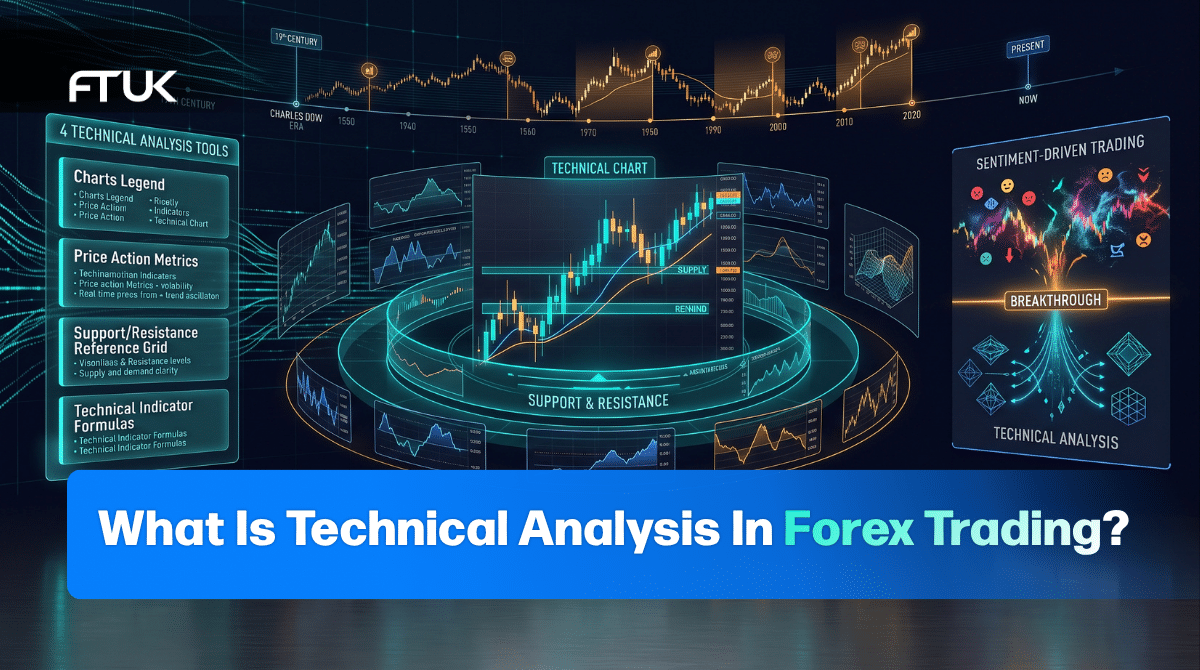
The idea of technical analysis dates back to the 19th century and the pioneering work of Charles Dow. In a nutshell, it uses a lot of historical data to highlight patterns and trends that can show how a particular situation is likely to develop.

In effect, it means that if the market has repeatedly behaved in a certain way in response to a particular set of circumstances in the past, this is likely to happen again.

This will provide a good indicator of where the successful opportunities will be found and what should be avoided. Why Is The Disciplined Use Of Technical Analysis Better Than Following Sentiment?

An example of this might be the kind of situations where a ‘bubble’ can develop, as market sentiment sees investors pile into a particular prospect and leave lots of opportunities for short-term gains, but the longer-term danger is that the bubble will burst.

However, rather than getting dragged aboard a sentiment-led market bandwagon, traders can use technical analysis to take emotion and hype out of the equation.

Instead, technical analysis provides a data-led approach to trading that provides a basis for a more disciplined approach, rather than chasing flights of fancy. Using a rules-based approach, traders, especially new ones, can make smarter choices.

In particular, traders can apply stop-loss arrangements based on what the analysis tells them, avoiding risky transactions, while technical analysis will make it easier to spot emerging trends and also, just as importantly, reversals in them. What Are The Key Tools Of Technical Analysis?

Key elements of the dataset that technical analysis will rely on include

Various charts that highlight historical data and trends

Price action, which uses price movement as an indicator of the direction of a trend

Support and resistance, which are identifiable price levels at which supply and demand are clearest

Technical indicators, which use mathematical tools focused on factors such as price, volume of trades or volatility to indicate the direction of travel

The key for traders who want to be successful is to take into account as much information as possible. However, it is impossible to think of everything all the time, especially as trading goes on all over the world 24/7.

Moreover, whereas fundamental analysis can be tied to events that are fixed in the calendar, such as the dates of interest rate decisions, elections or the publication of economic data, technical analysis deals with fluid situations that develop continually.

In order not to get swept along with the tide, traders using technical analysis can use trend data instead of emotion to predict likely outcomes with confidence and trade accordingly, producing more reliable trades based on tried-and-tested data.

How To Set Up A Risk Management Policy For Forex Trading

How To Set Up A Risk Management Policy For Forex Trading

If you ask experienced forex traders what separates those who survive from those who disappear after a few months, very few will say it’s finding the perfect strategy. Instead, they’ll usually attribute stickability to good risk management.

The reality is that profitable trading isn’t about avoiding losses altogether. Every trader experiences losing trades, losing days and sometimes even losing weeks. The difference is that successful traders plan for those losses before they happen.

Whether you’re trading your own capital or working towards a funded account through a pay after you pass prop firm challenge, having a written risk management policy can make your decision-making more consistent and help remove emotion from the process.

This guide explains how beginners and intermediate traders can create a practical risk management policy that supports long-term development rather than chasing quick profits. What is a forex risk management policy?

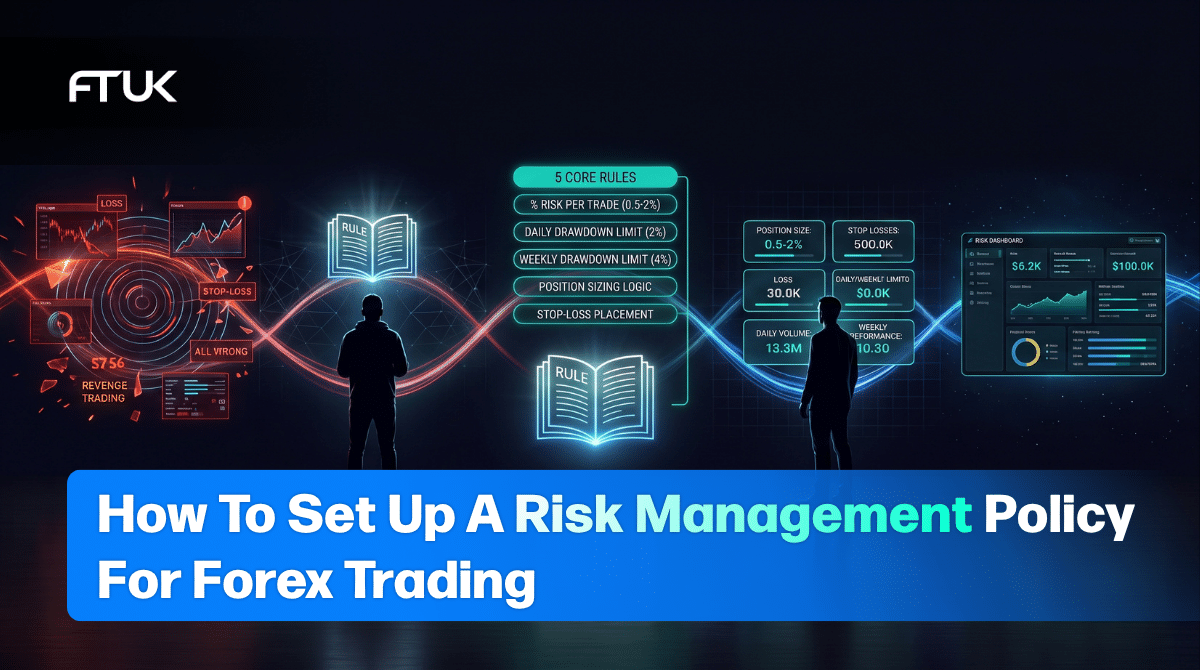
Think of your risk management policy as the rulebook for your trading business .

Instead of making decisions based on ‘gut feeling’ or what happened in your last trade, you have predefined rules covering

How much you’ll risk on each trade

Maximum daily and weekly losses

Position sizing

Stop-loss placement

Maximum leverage

Trading hours

Acceptable market conditions

When to stop trading

Professional traders rarely leave these decisions until they’re already in a position. The rules are established before the trading day begins. Why every forex trader needs written rules

One of the biggest mistakes beginners make is believing they’ll ‘just know’ when to exit a losing trade. Unfortunately trading psychology doesn’t usually work that way. Once real money is involved, emotions can quickly take over.

Without written rules, it’s easy to

Move stop losses further away

Increase position sizes after losses

Revenge trade

Hold onto losing positions hoping they’ll recover

Take unnecessary trades out of boredom

A written policy removes much of this decision-making.

Instead of asking: “What should I do now?” You simply follow the plan you created while thinking clearly. Step 1: Decide your maximum risk per trade

This is the foundation of almost every successful risk management plan Many traders choose to risk somewhere between 0.5 per cent and 2 per cent of their account on any single trade.

Beginners often stay towards the lower end until they gain more experience. The exact percentage matters less than applying it consistently.

For example

£10,000 account

0.5 per cent risk = £50

1 per cent risk = £100

2 per cent risk = £200

Notice that these figures remain the same regardless of how confident you feel. Confidence doesn’t guarantee the outcome of a trade: a consistent approach is always the best way to manage risk. Step 2: Calculate position size properly

One of the biggest misconceptions among new traders is choosing a lot size first. Professional traders work backwards.

The process should look like this

– Find the trade setup

– Identify the logical stop-loss location

– Measure the stop distance

– Calculate the position size that matches your chosen risk

This means every trade risks roughly the same percentage of your account, even if the stop-loss distance changes. Without position sizing, one trade might risk five times more than another without you even realising. Step 3: Always define your exit before entering

Before placing any trade, you should already know

Entry price

Stop-loss

Profit target

Risk-to-reward ratio

If you don’t know where you’ll exit if you’re wrong, you shouldn’t enter the trade. Many experienced traders would rather miss an opportunity than enter without a defined risk. Step 4: Set a maximum daily loss

Even good traders experience bad days. The problem begins when one losing trade turns into five. Your policy should include a daily stop.

For example

Stop trading after losing 2 per cent in one day

Maximum three losing trades

Stop trading if you break your own rules

Once you reach that limit, the trading day ends. Tomorrow is another opportunity. Step 5: Set weekly drawdown limits

Daily limits prevent emotional spirals. Weekly limits help prevent larger account damage.

Examples include

Maximum weekly loss of 4 – 6 per cent

Review all trades before trading again

Reduce position size after difficult weeks

Remember: The objective isn’t to trade every day. The objective is to still be trading six months from now. Step 6: Understand risk-to-reward ratios

Winning percentage isn’t everything. Many beginners believe they must win most of their trades. That’s not necessarily true: let’s take the example of two traders.

Trader A

Wins 80 per cent

Risks £100

Makes £50

Trader B

Wins 45 per cent

Risks £100

Makes £250

Trader B could still be more profitable despite winning fewer trades. This is why many traders aim for a favourable risk-to-reward ratio, such as risking £1 to potentially make £2, while recognising that no ratio guarantees profitability. Step 7: Control leverage

Leverage is one of forex trading’s greatest advantages. It’s also one of its biggest risks. Leverage increases both profits and losses.

Using high leverage without proper controls can cause large account swings from relatively small market moves. Your risk policy should therefore focus on limiting overall exposure rather than simply using the maximum leverage available.

Many developing traders deliberately trade smaller than necessary while they build consistency. There’s nothing wrong with growing slowly. Step 8: Avoid overexposure

Imagine opening these trades

EUR/USD

GBP/USD

EUR/GBP

They may look different, but they’re heavily related. A single piece of economic news affecting the US dollar or the Euro could move all three positions.

Your policy should include limits such as

Maximum number of open trades

Maximum exposure to one currency

Maximum exposure before major news releases

Diversification applies to forex too. Step 9: Have rules around news events

Major announcements can create sharp volatility.

Examples include

Interest rate decisions

Inflation data

Employment reports

Central bank speeches

Some traders specialise in these events. Others avoid them completely. Neither approach is automatically right. The important thing is having clear rules.

Examples

No new trades within 15 minutes of major announcements

Reduce position size during high volatility

Close existing trades before key releases if they don’t fit your strategy

Step 10: Know when not to trade

One of the most underrated trading skills is doing nothing. Not every market condition suits every strategy.

Your policy might state

Do not trade if

You’re tired

You’re emotional

You’re physically unwell

You’re distracted

You’re forcing trades

Market conditions don’t match your plan

Sometimes protecting capital means staying out of the market. Include psychological rules

Trading psychology deserves its own section in your policy. Write rules that protect you from yourself.

For example

“I will never move my stop loss further away.”

“I will not revenge trade.”

“I will accept losing trades.”

“I will follow my plan regardless of the previous trade.”

These simple statements sound obvious, but they’re surprisingly difficult to follow when emotions take over. Keep a trading journal

Every professional athlete reviews performance, and forex traders should too.

Record

Why you entered

Why you exited

Risk percentage

Market conditions

Emotional state

Result

Lessons learned

After 100 trades you’ll begin spotting patterns

Perhaps your best trades happen in London market hours

Perhaps you lose when you’re tired

Perhaps your biggest losses come after breaking your own rules

Your journal becomes one of your most valuable learning tools. Adjust risk as your experience grows

Your policy shouldn’t stay identical forever.

As your experience develops, you might gradually adjust

Position size

Maximum exposure

Trading sessions

Strategy selection

Markets traded

However, changes should come after reviewing a meaningful sample of trades, not because of one particularly good or bad week. Avoidmaking emotional adjustments Make evidence-based improvements. Risk management during a prop firm challenge

If your goal is earning access to a funded trading account, risk management becomes even more important.

Most prop firm evaluations include rules such as

Maximum daily drawdown

Maximum total drawdown

Profit targets

Consistency requirements

Passing usually isn’t about producing spectacular returns. It’s about demonstrating disciplined decision-making over time.

Many traders fail challenges not because their strategy is poor, but because they increase risk after losses, overtrade or ignore the firm’s rules.

A disciplined risk management policy can help you stay within those limits and show the consistency that funded programmes are designed to assess.

Every trader dreams about finding the strategy that produces consistent profits. But the best strategies are not set in stone. They are designed to respond to volatile markets and increasingly uncertain economic conditions.

Your first objective should never be to make as much money as possible as quickly as possible. Your first objective is to stay in the game long enough to become a better trader.

Treat your trading like a business rather than a gamble. Accept that losses are part of the process, commit to a written plan, and review your performance regularly.

Over time, disciplined risk management won’t eliminate losing trades, but it can help ensure that no single mistake defines your trading journey.

How To Tell If Trading Is Right For You

How To Tell If Trading Is Right For You

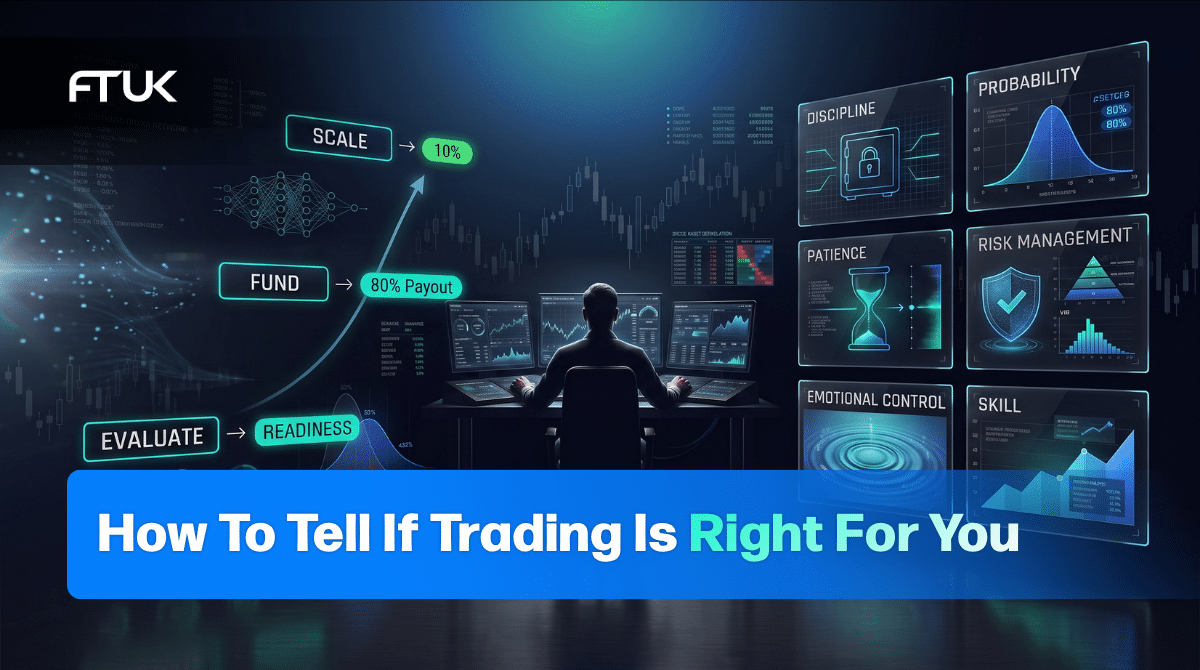
Forex trading has become increasingly accessible, with prop firms now offering structured evaluation programs for newer traders and even instant funding for more experienced traders.

On the surface, the appeal is obvious: trade with significant capital, keep a share of the profits, and scale up over time without risking your own savings. But here’s the truth: access to capital is the easy part. Becoming consistently profitable is the hard part.

If you’re considering joining a prop firm, whether through a one-step or two-step evaluation, or jumping straight into an instant funding model, this guide will help you decide if forex trading genuinely fits your mindset, lifestyle, and long-term goals. What does forex trading really involve?

Before anything else, it’s important to strip away the hype. Forex trading is not a shortcut to quick money. It’s a performance-based skill that combines analysis, decision-making, discipline, and emotional control under pressure.

You’re operating in a global market that reacts to economic data geopolitical events, and institutional flows, often in seconds. Even with a funded account, you are still responsible for managing risk.

Prop firms provide capital, but they also enforce rules: maximum drawdown limits, profit targets, and consistency requirements. These aren’t arbitrary; they’re there to test whether you can trade professionally. Should new forex traders work with a prop firm?

Modern prop firms have lowered the barrier to entry significantly. Typically, you’ll encounter three routes: 1. One-step evaluation program

A single phase where you must hit a scaling profit target while staying within risk limits. You will need to pass a single test to access a fully funded account. This option is best suited for traders who have some market experience and a stress-tested strategy. 2. Two-step evaluation program

A more gradual process that tests consistency over two stages, often with slightly lower pressure in each phase, and also a lower sign up fee. This is ideal if you have little or no previous experience, because it helps you understand the process more thoroughly. 3. Instant funding program

The instant funding program bypasses the evaluation phases so you can start trading in live market conditions from the get-go. This is for traders who are confident in their abilities and are able to manage risk and earn steady profits.

In many cases, evaluation fees are refundable once you pass, which reduces financial risk. Profit splits often start around 50 per cent and can scale up to 80 – 90 per cent as you demonstrate consistency. What are the key traits of successful forex traders?

Although there’s no one fixed path to becoming a successful forex trader (and there are always exceptions who prove the rule) most traders who are in it for the long haul tend to have some traits in common: 1. You can follow rules without exception

Prop firm trading is rule-driven. Maximum daily loss overall drawdown, lot size limits: break them, and your account can be terminated.

If you’re someone who tends towards off-the-wall strategies or takes impulsive risks, this environment will expose that quickly. Successful traders treat rules as non-negotiable, not guidelines. 2. You think in probabilities, not certainties

This might seem to contradict the ability to follow rules, but it doesn’t mean just making it up as you go along. Rather, it means having the wisdom to understand that no strategy wins 100 per cent of the time. Even the best traders experience losing streaks.

If you feel the need to be right on every trade, forex trading will frustrate you. What matters is executing a system where, over timere managing probabilities .

– You’re patient and can bounce back

Most funded traders don’t pass evaluations on their first attempt. And even after getting funded, scaling an account takes time. If you’re expecting quick wins or immediate income, you’re likely to make emotional decisions that lead to failure. 4. You can manage emotions under pressure

Trading triggers very real psychological responses fear, greed, frustration, overconfidence. A losing trade can tempt you to reckless revenge trading. A winning streak can lead to overleveraging.

The traders who succeed aren’t emotionless, but they don’t let emotions dictate their actions. What separates them is awareness and control.

They recognise when emotions or mental habits are influencing their thinking and have systems in place to stay grounded, whether that’s predefined risk per trade, strict entry and exit rules, or simply stepping away from the screen after a loss.

They don’t chase the market, and they don’t try to make back lost money quickly. Just as importantly, they stay level-headed during winning periods. Confidence is useful, but unchecked, it often leads to careless mistakes.

Consistent traders stick to the same process whether they’re up or down, understanding that long-term success comes from discipline, not short-term emotional reactions. 5. You’re willing to treat it like a skill, not a gamble

Forex trading sits somewhere between a profession and a performance sport. It requires

Structured learning

Strategy development

Backtesting

Journaling trades

Continuous improvement

If you approach it casually, the results will be inconsistent. If you approach it seriously, you at least give yourself a chance. Are prop firm evaluations programs worth it?

A lot of people see prop firm evaluations as a hurdle. In reality, they’re a filter, and a training ground.

A one-step or two-step challenge forces you to

Trade within strict risk parameters

Hit defined profit targets

Demonstrate consistency over time

If you can pass, it’s proof that you’ve got what it takes to be a profitable trader, and this confidence will carry through as you enter the live markets.

If you don’t pass, treat it as feedback rather than failure. There’s no limit on the amount of attempts you can make, so work out what went wrong, leif you can, and try again. Remember that most of the time, most of us are just learning to fail better.

The mistake is rushing through evaluations without preparation. Treat them as a test of your process, not a lottery ticket. Is instant funding a good option for forex traders?

Instant funding can be attractive if you already have experience and confidence in your strategy. It removes the pressure of hitting evaluation targets and gets you straight into a live funded environment.

However, there are trade-offs

The fee is typically non-refundable

Risk limits may be tighter

There’s no practice phase to refine your approach

If you haven’t already demonstrated consistent profitability, even on a demo account, jumping straight into instant funding is usually a mistake. Be honest with yourself here. Skipping the evaluation doesn’t mean skipping the learning curve. What type of lifestyle can you realistically expect from forex trading?

Another point worth considering: forex trading is often sold as the dream freelance lifestyle, working a few hours from a sunny poolside each day before retiring for golf or cocktails. Yes, it can offer flexibility, but in the early stages, it often demands

Screen time and focus

Routine and structure

Ongoing analysis and review

You may need to align your schedule with specific market sessions (London, New York), depending on your strategy. It’s not passive income, especially not at the beginning. What are the signs forex trading might be right for you?

You don’t need to be perfect, but certain indicators suggest a good fit

You enjoy analysing patterns, data, or markets

You’re comfortable working independently

You can stick to a plan without constant external pressure

You’re willing to invest time in learning and improving

You accept that losses are part of the process

If that sounds like you, forex trading could be a viable path, especially with the support structure of a prop firm. Signs forex trading might not be the right fit for you

Equally important is recognising when it’s not a match

You’re looking for fast, guaranteed income

You struggle with discipline or impulsive decisions

You find it hard to handle financial uncertainty

You’re not willing to track and review your performance

You expect external factors (signals, tips) to do the work for you

None of these are permanent limitations, but they are barriers you’ll need to address before succeeding. What is the most realistic path to forex trading?

If you’re serious about exploring forex trading with a prop firm, take a structured approach

Learn the basics – Understand how the market works, key terminology, and risk management.

Develop a strategy – Keep it simple, test it thoroughly.

Practice on demo – Prove consistency before risking fees.

Choose the right evaluation model – One-step for confidence, two-step for progression.

Treat it professionally – Journal trades, review mistakes, refine your process.

Prop firms offer unique advantages: the ability to trade large accounts without risking your own capital, earn a meaningful profit split, and scale into substantial capital is a genuine opportunity, but it comes with responsibility.

The traders who succeed aren’t the ones chasing dollars; they’re the ones who build the discipline, consistency, and mindset required to keep it. If you’re prepared to approach forex trading with that level of seriousness, it can be a deeply rewarding path.

The Best Books On Trading Psychology

The Best Books On Trading Psychology

In such a highly advanced financial market where technical analysis, focused trading plans and an unfathomable amount of information are used to make trades very quickly, it can be difficult to remember that financial markets are largely made up of humans and thus human error.

Given that a truly efficient market is not only impossible but would cause the entire system to collapse because profit comes from inefficiency, your mindset and the mindset of every other trader are central to making your return.

This is why applicants for the Instant Funding programme at our prop firm come from a diverse range of backgrounds; succeeding in the forex market requires not only a working knowledge of the markets but an understanding of the difference between the markets and how many other investors see them.

This is why trading psychology matters and why it is important to understand not only how the forex market is supposed to work, but also how other people think it is supposed to work, and the types of heuristics, biases and base emotions that drive decision making.

Here are a few of the most interesting books on trading psychology, from a broad spectrum of schools of thought and throughout the history of financial markets. Whilst markets such as the modern forex market are relatively recent, the psychology that underpins them has existed since time immemorial.

The one rule for this list is that they have to be published books, rather than articles or studies published in journals.

Extraordinary Popular Delusions and the Madness of Crowds

One of the very first books on herd mentality, The Madness of Crowds focuses on a wide range of unusual beliefs and historical events, but the first volume is a particularly important early account of economic bubbles and how they catalyse and spread.

Whilst some of the facts surrounding Tulip Mania have been scrutinised in recent decades, and author Charles Mackay was allegedly involved in the Railway Mania bubble of the 1840s, the book is a highly entertaining introduction to the concept and a fun place to start if you are a fan of history.

Bernard Baruch, a major 20th-century financier, cited the book as the reason he sold his stock ahead of the Wall Street Crash.

Key Takeaways

Traders will not always act with rational self-interest.

The driving emotions of fear and greed can cause wild swings in financial markets.

Beware of irrational exuberance and investments where the price is at odds with the value.

Noise: A Flaw In Human Judgment

The late psychologist Daniel Kahneman is a vital figure in the field of trading philosophy; he essentially invented, along with Amos Tversky, tas loss aversion in financial trading.

Many of his books are must-reads if you want to understand why your mind works whilst trading and why you might be prone to making the same mistakes under pressure.

In particular, Thinking Fast And Slow highlights why rushed judgements feel so certain but can be very different to slower deliberations.

However, his final book, Noise: A Flaw In Human Judgement, is even more vital for traders, as it explores the types of factors that affect our judgment and lead the same person to come to very different conclusions whilst armed with the same data.

Whilst its focus is broader than financial markets, and focuses on some Freakonomics-style examples like how the weather can affect which skills will get people into college, it does provide some food for thought on why noise matters and why it should be understood and reduced, even if it cannot be eradicated.

Key Takeaways

Decision hygiene is essential to removing sources of noise that can affect investment results.

Small changes in approach can have huge differences in results.

Noise and bias are interconnected, and reducing the variability of noise can reveal the heuristics that lead to trading mistakes.

Trading In The Zone

One of the ultimate guides to trading psychology, Mark Douglas’ Trading In The Zone has become a borderline-foundational guide for navigating the psychological aspects of trading and building a toolkit of strategies and systems that can help you navigate the emotional aspects of trading.

It is often the first book new traders are recommended to read, and it is difficult to argue with that, given its emphasis on discipline, emotional control, and discovering one’s “edge” in the market.

Key Takeaways

Focus on what you can control, rather than trying to control the market.

Build your confidence throughout your trading strategy and edge, and reward your discipline rather than your results.

Your emotions affect your results, and recognising this power will give you a significant boost.

Trend Trading: What It Is And How To Do It

Trend Trading: What It Is And How To Do It

The secret to trading forex is extremely simple in theory and almost impossibly difficult in practice, which has led to the development of a wide range of trading philosophies.

This is part of the reason why the market is so liquid, volatile and fascinating, with countless forex traders taking advantage of prinstant funding programmes in order to challenge themselves against the market and make money doing it.

The ultimate aim is to sell an asset for more money than it cost to buy, but calculating the exact bottom of a valley or top of a peak is nemillions of traders

One of the most popular trading strategies is trend trading, to the point that many traders trust the trend as their greatest ally when dealing with short-term price fluctuations.

Successful trend analysis and trading strategies built on that data can lead to successful returns for years, if not decades, without relying as much on chance.

What is trend trading? How does it work? Should you always trust the trend? And how can you ride trends to long-term returns?

What Is Trend Trading?

It is often said that the best friend of traders is the trend, but what is it, and how does it change your trading strategy?

A market trend is the overall direction a trading market, an asset or a currency is travelling in terms of value.

Whilst the price action constantly changes on a moment-to-moment basis, the trend demonstrates whether the overall value of a particular asset ias the momentum of any change.

Trading a market trend involves identifying the direction of the market, entering the market at a relatively low point and sticking with your investment until a reversal in the trend becomes clearly identifiable.

It is also known as “trend following”, because traders are not necessarily forecasting, market making or blazing a new trail when it comes to their investment strategy, but instead are identifying the prevailing wind and lowering their sails to catch it.

How Does Trend Trading Work?

Trend trading is a relatively intuitive strategy that has historically been very successful. Many traders, particularly individual retail traders, begin by using some variation of trend trading whilst they learn other forms of analysis and how to read their market of choice.

It typically involves finding a breakout following a relative low point, investing at a relatively early stage and then exiting once you identify a downward trend.

This is done by following market indicators rather than the noise of the market itself a level of volatility is natural in any market, but it can provide false positives if you solely follow basic price data as an indication of whether a currency is appreciating or depreciating in value.

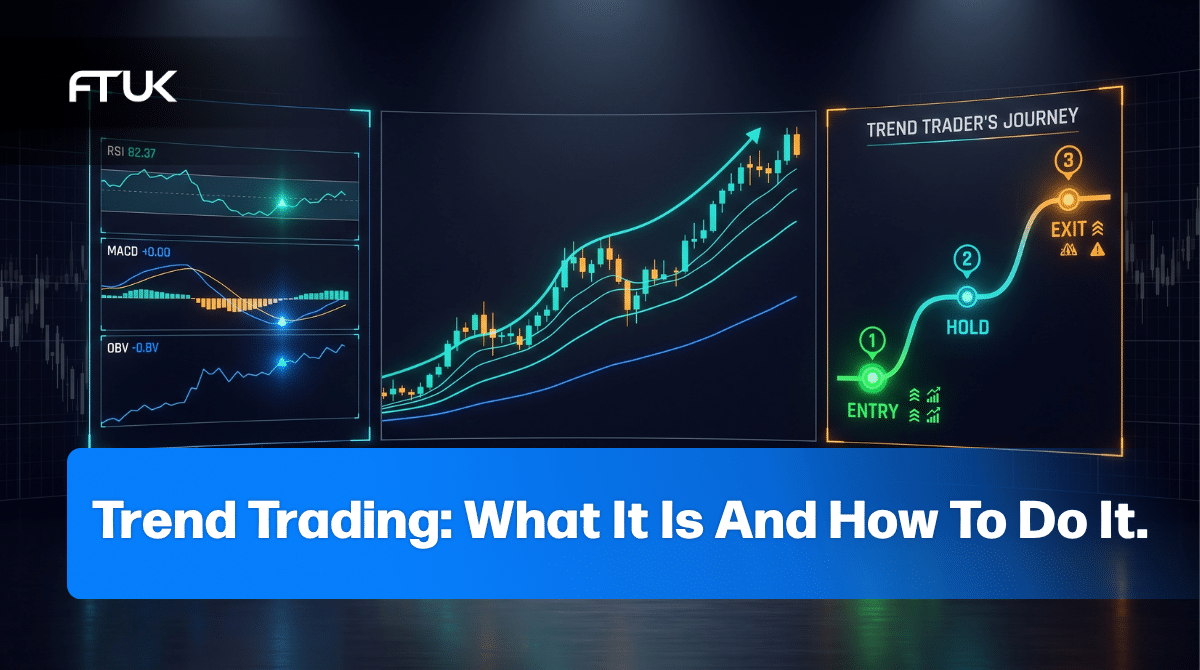
Commonly Used Market Indicators For Trend TradingMoving Averages

A moving average averages the closing price of an asset over a set period of time, which eradicates the effect of market noise and focuses on the overall trending direction of an asset. Relative Strength Index

The other type of RSI, this calculates how quickly prices are moving, using a scale from one to 100. Moving Average Convergence Divergence

Also known as MACD, this uses momentum and moving averages to highlight not only the direction of a market trend but also whether the price is moving faster or slower. On-Balance Volume

Known as OBV, this marker focuses on the volume of trades rather than strictly the price, with the idea that the more an asset is traded, the more likely a price movement is and the greater the chance of a trend breakout or confirmation.

Turtle Traders

Whilst trend trading has existed for many years, it became incredibly notable thanks to the Turtle Traders Experiment, where commodity trader Richard Dennis bet his partner William Eckhardt that he could train anyone to trade effectively, rather than it being an inherent special ability of his.

To settle this argument, he gave people who had never traded before his strategy and his money to bet on the financial market by buying a stock when it was trending upwards and selling when it traded downwards.

In just five years, the “turtles” he trained earned over $175m, highlighting that traders who were willing to learn could trade successfully even if they were relative novices.

Should You Always Trust The Trend?

The golden rule of trend trading is “do not fight the ticker tape”. In other words, always trust the trend and invest accordingly.

Should you, though? Whilst trend trading can be successful, it is extremely vulnerable to false positives, which can turn a relatively intuitive and safe trade into an expensive drawdown.

In general, trend trading works best in markets with relatively low volatility, as you are reliant on lagging indicators that are a few steps behind the present market situation.

As well as this, whilst trends are more long-term, a breakout or trend reversal can happen at any time, and as the exit signal needs to be shorter than the entry signal, it can sometimes lead to false moves. This should be factored into your risk management strategy.

Top Tips To Successfully Trade TrendsFocus On Price Indicators

Whilst volume can be a useful indicator, the present price should be the main driver of any trend trading decision. Avoid relying on commentary for your trading advice. Know How Much To Invest

The key strategy for trend following is ensuring that you do not risk too much on single trades. Never invest more than two per cent of your overall account. Plan Your Exit Carefully

As you have less time for your exit than your entry, you should plan the former as much as you would the latter. Know when to hold for profits, when to take your money and when to cut losses. Diversify Your Portfolio

Make sure your larger positions are in less volatile currency pairs, and you have as little exposure to volatility as possible. Big Returns Mean Big Drawdowns

A side effect of trend trading is the risk of false moves, which means deep drawdowns on certain investments. Prepare your risk management strategy accordingly.

5 Effective Trading Strategies For Forex Beginners

5 Effective Trading Strategies For Forex Beginners

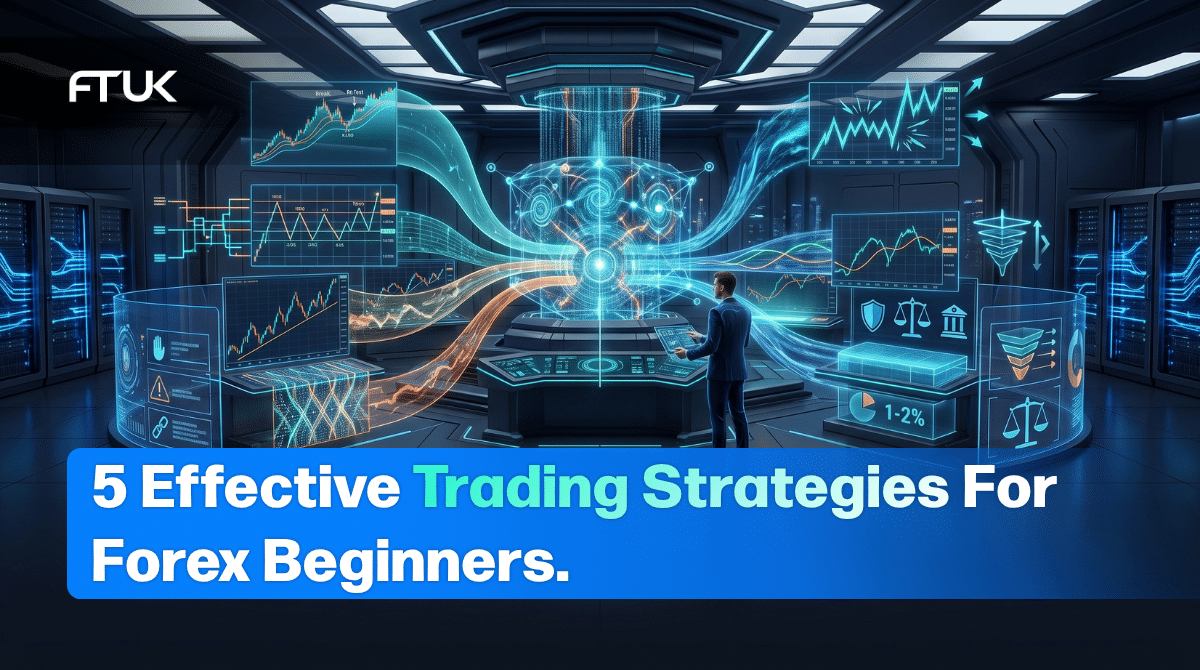
Succeeding at forex trading doesn’t require bags of qualifications or natural talent, but you do need to follow structured, repeatable strategies with discipline. Without this, it’s easy to make impulsive decisions and lose confidence and capital fast.

If you’re new to forex, especially if you’re aiming to pass a prop firm challenge or trade funded accounts, these five beginner-friendly strategies provide a solid foundation. Each one is simple enough to understand, but effective when applied consistently. 1. Trend following strategy

Best for: Beginners who want a straightforward, low-stress approach

Timeframes: one hour, four hour, daily charts

The trend is your friend. It’s one of the most repeated phrases in trading, and for good reason Trend following is about identifying the overall direction of the market (uptrend or downtrend) and trading in that direction.

Instead of trying to predict reversals, you’re simply aligning yourself with momentum.

How it works

Identify higher highs and higher lows (uptrend), or lower highs and lower lows (downtrend)

Use indicators like moving averages (e.g. 50 EMA and 200 EMA)

Enter trades when price pulls back to a key level within the trend

Example

If EUR/USD is consistently making higher highs, you wait for a pullback and look for buying opportunities, not sells.

Why it works for beginners

Reduces decision fatigue

Avoids counter-trend trades (a common beginner mistake)

Encourages patience and discipline

Best practice: Don’t chase price. Wait for pullbacks; this is where the best risk-to-reward setups occur. 2. Support and resistance trading

Best for: Visual learners and price-action traders

Timeframes: All (but especially 15-min to four hour)

Support and resistance levels are areas where price has historically reversed or stalled. These levels act as psychological barriers in the market.

How it works

Identify key horizontal levels where price has bounced before

Buy near support and sell near resistance

Look for confirmation (e.g. rejection candles, wicks, or consolidation)

Example

If GBP/USD repeatedly bounces off 1.2500, that level becomes support. A beginner trader might look for buying opportunities when price returns to that zone.

Why it works for beginners

Easy to understand visually

Doesn’t require complex indicators

Builds awareness of market structure

Common mistake

Placing trades exactly at the level without confirmation. Price often breaks levels before reversing, so patience is key.

Best practice: Combine support/resistance with trend direction. Trading with both significantly increases your probability of success. 3. Breakout trading strategy

Best for: Traders who like momentum and volatility

Timeframes: five min to one hour (intraday focus)

Breakouts occur when price moves beyond a defined level of support or resistance with strong momentum. This often leads to sharp moves, creating profitable opportunities.

How it works

Identify consolidation zones or tight ranges

Wait for price to break out with strong momentum

Enter in the direction of the breakout

Example

If USD/JPY trades within a tight range for several hours, a breakout above resistance may signal a strong upward move.

Why it works

Captures strong market moves early

Works well during high-volume sessions (London/New York opens)

The catch

False breakouts are common, especially for beginners who enter too early.

How to avoid false breakouts

Wait for a candle close beyond the level

Look for increased volume or strong momentum

Avoid trading during low-liquidity periods

Risk tip

Always use stop-losses. Breakout trading can be fast, and unforgiving without proper risk management. 4. Moving average crossover strategy

Best for: Beginners who prefer indicator-based trading

Timeframes: one hour, four hour, daily

This strategy uses two moving averages to generate buy and sell signals. It’s one of the simplest ways to identify trend shifts.

How it works

Use a short-term moving average (e.g. 50 EMA)

Use a long-term moving average (e.g. 200 EMA)

Buy when the short-term MA crosses above the long-term MA

Sell when it crosses below

Example

If the 50 EMA crosses above the 200 EMA, it signals a potential bullish trend.

Why it works for beginners

Clear, rule-based signals

Removes emotional decision-making

Helps identify trend changes early

Limitations

Signals can lag behind price

Can produce false signals in ranging markets

Best practice

Use this strategy alongside price action. Don’t rely on indicators alone: combine them with market structure for better accuracy. 5. Risk management-based strategy

Best for: Every trader, especially beginners

Timeframes: All

This isn’t a strategy in the traditional sense, but it’s the difference between traders who survive and those who don’t. Many beginners focus entirely on entries, but professionals focus on risk.

Core principles

Risk only one to two per cent of your account per trade

Always use a stop-loss

Maintain a minimum 1:2 risk-to-reward ratio

Avoid overtrading

Example

If you risk £100 on a trade, your potential profit should be at least £200.

Why it matters

Even with a 50 per cent win rate, you can still be consistently profitable with proper risk management. You can have the best strategy in the world, but without discipline, you’ll still fail.

For prop trading, this is critical. Most prop firms evaluate traders based on

Drawdown limits

Consistency

Risk control

Blowing your account, even with a good strategy, means failure. How to choose the right forex trading strategy

Here’s where most beginners go wrong: they try everything at once. You don’t need five strategies. You need one strategy that you understand and can execute consistently. The goal early on is to build confidence, discipline, and pattern recognition.

A strategy only works if it fits your personality and lifestyle. This is where a lot of traders sabotage themselves. They copy what they see online without asking whether it actually suits how they think or how they live.

Ask yourself

Do I prefer slow, steady trades or fast-paced action?

Am I comfortable using indicators or do I prefer clean charts?

How much time can I realistically commit each day?

Be honest here. If you have a full-time job or other commitments, trying to scalp the markets on a five minute chart is going to burn you out quickly.

On the other hand, if you enjoy being active and making quick decisions, waiting days for a setup on higher timeframes may lead to impatience and poor trades.

Simple guide

Busy schedule? – Trend following (higher timeframes)

Like visual setups? – Support & resistance

Enjoy fast trading? – Breakouts

Want rules-based signals? – Moving averages

Once you’ve chosen, commit to it properly. That means backtesting it, journaling your trades, and tracking your results over time. Give it enough data (at least 30 to 50 trades) before you even consider changing anything.

Also, accept that no strategy wins all the time. Losses are part of the process. What matters is whether your approach is profitable over a series of trades, not whether the last trade was a win or loss. Common beginner forex trading mistakes to avoid

Let’s be direct: most new traders don’t fail because of strategy. They fail because of behaviour.

You can hand two people the exact same strategy, and one will grow an account, the other will blow it. The difference comes down to discipline, patience, and emotional control. 1. Overtrading

More trades don’t equal more profit. It usually means more mistakes. Beginners often feel like they need to be in the market constantly. In reality, the best traders are selective. They wait for high-quality setups and ignore everything else.

If you’re taking trades out of boredom, you’re not trading; you’re gambling. 2. Revenge trading

Trying to win back losses quickly leads to bigger losses. This is one of the fastest ways to destroy an account. After a losing trafrustration anger urgency You abandon your plan and start forcing trades.

The fix is simple but not easy: step away. One trade doesn’t define your performance; your next decision does.

– Ignoring risk management

One bad trade can wipe out weeks of progress. This usually manifests in behaviour such as moving stop-losses, risking too much per trade, or doubling down after a loss.

It only takes one undisciplined moment to undo a lot of good work. Professionals protect their downside first; profits come second. 4. Strategy hopping

Jumping between strategies prevents mastery. If you switch strategies every time you lose, you never give yourself a chance to improve. Every approach has losing streaks.

The traders who succeed are the ones who stick with a method long enough to understand its strengths and weaknesses. 5. Unrealistic expectations

Forex is not a get-rich-quick scheme. It’s a skill. Social media has distorted what trading actually looks like. Consistent profitability takes time – often months or years of practice. If you expect instant results, you’ll take unnecessary risks trying to speed up the process.

Remember, your biggest edge isn’t your strategy: it’s your ability to follow it. Summing up

If you’re aiming to trade with a prop firm, your initial focus shouldn’t be on making huge profits; it should be on proving you can follow rules, manage risk, and stay disciplined under pressure.

That’s what funded trading is really about. Start simple, stick to one strategy, track your results, and be prepared to improve gradually. This way, you will develop the discipline and consistency that separates successful traders from the rest.

5 New Year’s Resolutions For Forex Trading Success

5 New Year’s Resolutions For Forex Trading Success

The spirit of good cheer and goodwill always fills the air at the start of a new year, and it is the perfect time to celebrate your successes in the previous year, whilst also making plans and preparations for the future.

Last year was a hugely impactful and remarkably unusual year for pretty much everyone, but the volatility of financial and currency markets moften choppy forex seas a particularly fascinating challenge.

Everyone on the market deserves credit for their successes in unique times, as so many traders have been up to the challenge, working with prop funding to establish consistent gains in times that can be charitably described as inconsistent.

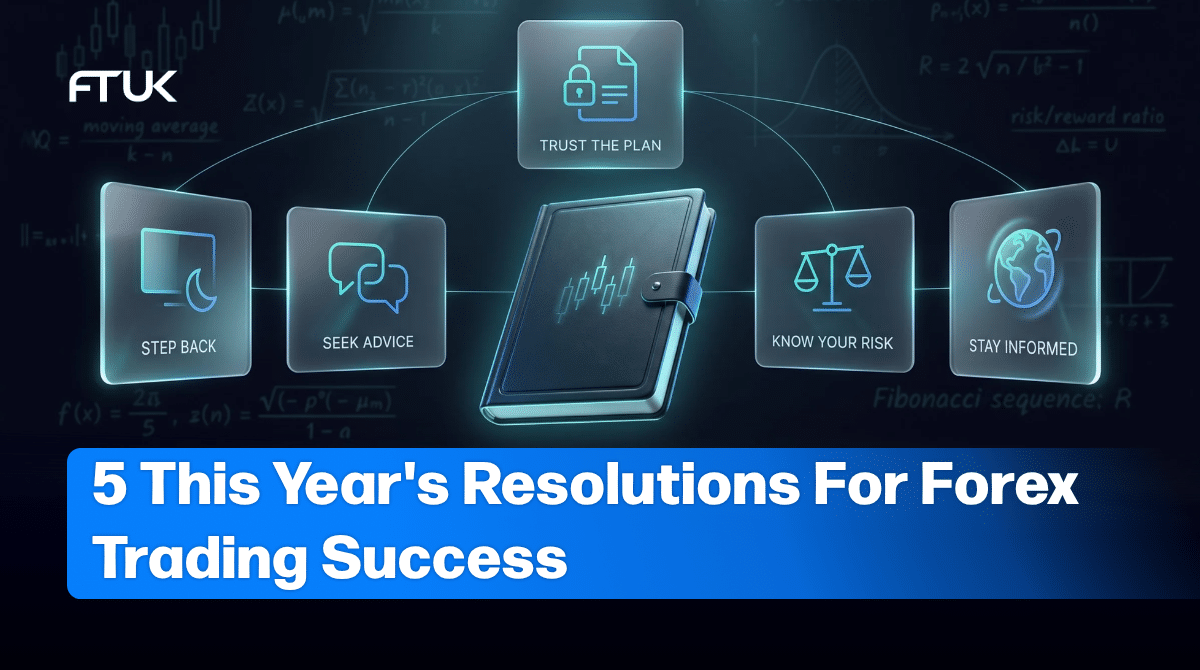
Whether you are giving forex a try for the first time in 2026, solidifying your gains from the previous year or embracing the chance at a clean slate, here are five New Year’s Resolutions that will help you succeed in 2026.

We are not following the SMART goal-setting system for our five resolutions, but instead providing five broader themes that you can take into your trading life.

Resolution 1: Take Time Away From The Trading Floor

Dedication, discipline and excellent time-management are all vital traits to succeed in trading, but what you do away from the platform matters as much as the strategies you take on it.

This does not simply mean doing your research, networking with other traders, developing your trading plan further or focusing on your skills gaps, but everything you do to preserve your mental and physical health.

Trading is incredibly unusual as so much of the work is done far before a trade, and once your plan is put into action, the goal is to monitor, make adjustments when necessary, and have the patience to let the market move in your direction.

Spending too much time on a trading platform can lead to overtrading, or the opening of many positions somewhat arbitrarily in order to find some trading action.

Even beyond this, it is important to step away, particularly if you have received bad news or do not feel in the best state to focus and give your best to the platform.

Resolution 2: Never Be Afraid To Ask For Trading Advice

Whilst financial trading can feel like a competitive zero-sum game at times, in reality, this is far from the truth, and the vast majority of other traders will be happy to offer advice and tips to help you get started.

There are so many resources where you can educate yourself on trading strategies and approaches, and asking for help from other traders can often open doors to new strategies and mindsets that can help you make significant and rapid improvements to your skills as a trader.

In general, asking for help is a virtue and not a vice, and we get much further in life together than apart.

Resolution 3: Stick To Your Trading Strategy

Consistency is king, and you make far more money with dozens of smaller trades that consistently make money than you do with one big, albeit successful roll of the dice.

At the centre of this is your trading strategy, often built around a specific trading plan with target currency pairs, price targets and stop-loss floors to ensure you do not take too much of a drawdown on each individual trade.

Trading plans frontload your decision-making; rather than having to quickly make plans to invest under pressure, a trading plan allows you to plan in advance and reduce the level of stress and anxiety that trading can provide at times.

Of course, all of this is only true if you stick to it, and it is often very easy to get carried away when an opportunity comes along that you simply cannot ignore.

Sticking to your plan will allow for much more consistent results and reduce the risk of a major loss, but if you feel like you need some room to take chances outside of your plan, have a cautious, considered approach to any exceptions.

In general, this will stop you from having to think heavily about every trade, but instead only think about your strategy every three to six months if it is no longer appropriate to the conditions of the market.

Resolution 4: Learn More About Your Risk Tolerance

It goes without saying that risk management is one of the most vital skills you can learn, and if you want to do training in a single element of trading that will make the biggest difference, risk management will help you lose less and make more.

A good place to start in the New Year is to examine how you trade and determine your risk tolerance, the level of uncertainty and loss you are willing to take in order to get a higher return.

In the context of forex, this is typically explored in the context of leverage, where some traders

borrow from a broker to take larger positions to maximise potential gains. The larger the leverage, the bigger both the potential returns and potential losses become.

Resolution 5: Keep Up With The News

Given the abject chaos of the last 12 months, it is understandable that a lot of traders have minimised the amount of news they follow, instead focusing on a more technical numbers-first approach.

However, it is important to keep up with macroeconomic and geopolitical events, as these can have colossal effects on exchange rates and the value of currency pairs.

This does not mean trading the news, which is not only a breach of some forex prop firms’ account rules but is often a high-risk strategy that can far more easily go wrong than right.

In fact, few professional traders actively trade the news, but instead anticipate potential changes and reactions ahead of time in order to make effective returns.

Doing so requires some understanding of the particular types of news stories that affect your target currencies, as well as confidence in the short, medium and long-term effects of these particular events.

Keeping up with world events can give you an advantage that can lead to financial benefits in the future.

What Are The Best Times To Trade Forex And For What Reasons?

What Are The Best Times To Trade Forex And For What Reasons?

There are many elements of forex trading that make it both unusual and highly desirable, but one of the most interesting is the fact that the market is open almost constantly.

Whilst it is not open 24 hours a day, seven days a week, it is open for five and a half days per week, meaning that regardless of when you trade and where you live, there is always an opportunity to invest, buy and sell.

This is wholly unlike the rest of the financial markets, which typically have very limited trading hours that require traders to either focus their investments into just a few hours of the day or to diversify across various continental markets.

It also means that as long as you have the prop firm funding to do so, you can invest whenever you like at any hour of the day. But should you?

Whilst you can invest whenever you like, you do not necessarily have to, and there are points during the day when trading activity and volatility are at its peak, unlocking opportunities for day traders, short-sellers and long-term investors alike.

Here is why forex trading hours are so unusual, what rookie traps to avoid and when you should trade to make the most of the market.

What Makes Forex Trading Hours So Strange?

Forex is often characterised as a 24-hour market that outside of a day and a half at weekends is always moving, but it is perhaps best to think of the forex market as four separate markets which overlap based in four separate markets

In order of opening times, here are the four main forex markets

Sydney, Australia.

Tokyo, Japan.

London, England.

New York, United States of America.

Generally speaking, this means that there is market activity at any hour of the day; however, certain currency pairs will only be traded at certain times, and this is where one of the most common rookie mistakes in forex is commonly made.

What Is The Biggest Rookie Error In Forex?

A lot of new forex traders assume that you need to focus on the market in totality. The assumption is that you need to keep track of every data release, every shift in the market, everything.

However, this is simply not realistic; traders often overtrade as it is, and trying to manage the entire market is a recipe for burnout.

There are two ways around this; one is to focus exclusively on the nearest stock exchange to you, and the other is to plan around the points the currency pairs you trade.

When Should You Trade Forex?

Ultimately, the best time to trade forex is during peaks of trading activity, which is usually when there are overlaps between the four markets.

Higher trading volumes mean more volatility, which in forex means there are greater fluctuations in value for the various currency pairs, allowing you to maximise your potential profits.

By contrast, a quiet market means much tighter ranges for sales and little opportunity for big news stories to provide volatility to the market.

With that in mind, here are some of the best times to trade forex.

When The Sydney Market Opens

The day-and-a-half lull following the close of the New York market on Friday means that traders will often want to act as quickly as possible, meaning that a lot of initial action takes place within the first few hours of the Sydney market opening.

This will quickly balance itself out, but it is a point where there are a lot of opportunities.

The New York/London Overlap

By far the busiest time for forex, over half of all trades take place between these two markets, with the US dollar and the pound sterling being two of the largest currencies in the world.

When the two markets overlap for four hours each day, the market is perhaps at its most volatile outside of major news events.

The Sydney/Tokyo Overlap

A particularly major overlap for EUR/JPY pairs, the two hours that Sydney and Tokyo overlap provide a great degree of volatility to take advantage of, particularly right at the start of the week before the US and UK markets open.

The London/Tokyo Overlap

It is open for just an hour and takes place when a lot of the market is still asleep, but there is the chance for a remarkable amount of action, although particularly gigantic moves are unlikely, given there is just 60 minutes of overlap.