THINK LIKE A WINNER

The best Forex traders think like a winner

Develop a successful trading mindset and a new life as a Forex trader. Discover out what it takes to become one of the best Forex traders.

Traders’ attitudes and opinions regarding the Forex market may include beliefs such as the market being rigged against them. When Forex traders have negative perspectives like this, their chances of successfully withdrawing earnings from the market are limited.

If you are always convinced that the Forex market is trying to specifically target you as a Forex trader, you will be unable to objectively analyse market opportunities. The Forex markets are entirely neutral. They don’t care if you gain or lose money; volume and price fluctuations are dependent on larger fundamental factors.

Forex trading with confidence

We can go forward with confidence and build on our plan if we believe in ourselves. Confidence in one’s ability to take risks is an essential component of every Forex trader’s mindset. Those that are profitable in Forex will have a lot of confidence in themselves since they are not inhibited by lost trades or other negative emotions.

All losing traders will have a lot of doubts about their capacity to win. Unfortunately, believing you have terrible luck or that the market is controlling you is the incorrect way to look at it if you are currently a losing Forex trader over a large sample size.

Doubting oneself after a loss may make you feel unwilling to act on the next trading setup or opportunity. A losing Forex trader is always afraid of the market reversing on them, and as a result, they may cut their wins too early, which can lead to further trading conflict down the line.

A successful trader would have a positive attitude even when their trading bias is incorrect and the Forex market goes against them. This is not a simple process since, as humans, we need to repair it quickly in order to restore our emotions.

Winning traders will maintain the confidence necessary to simply pull the trigger on trades when a true opportunity presents itself.

Understand how it works and experience

The best Forex traders understand the distinction between a simple bad trade and a trade that loses money. We always aim to be adaptable and keep a record of how the qualities of the currency change. If you lose money in a certain situation, it does not automatically imply that the trade was a bad one. In most circumstances, there will be a lesson associated with that trade.

To put it simply, a trade isn’t a good trade because it makes money. A solid trade has enough confluences and a favourable risk-reward ratio. Meaning there was more reward than risk in that given setup. Even if you then get stopped out with a loss. It is still a good trade if you managed it effectively and have good reasoning and research behind it.

On the other hand, just because a position produces a profit does not always imply that it is a successful trading setup. If you placed the trade with insufficient confluences or with more risk than return, it is still a bad trade, even if it earned a profit in the short term.

The law of large numbers

As Forex traders, we want to try to make great trades over and over again, based on sound rationale and a balanced risk-reward ratio on every single setting. Regardless of the result let’s try to find those positive trading setups. When it comes to trading history, if you only assess yourself by short-term wins and losses, your long-term performance will be random.

Profitable habits

As previously said, the finest Forex traders will benefit from preparedness. Week in and week out, the best Forex traders will continually assess and evaluate their performance. Understanding that it is a game of skill across a large sample size of trades will encourage you to practice your trades with a longer-term goal in mind.

The best Forex traders will be aware of market bias and short-term fluctuations. They will recognize when it is time to exit the trade and sit on their hands. They will also not hesitate if they see a high-probability trading opportunity that aligns with their alignments and technical strategies. They can then reduce their risk exposure by precisely calculating position size in accordance with management guidelines.

As the best Forex traders, we all have excellent prospects of trading with freedom in a free environment on our terms. However, self-discipline and setting boundaries for yourself will help you do a better job.

Find the solution within yourself

If you genuinely believe you are destined to be a millionaire trader, you must become extremely disciplined and make it your life’s work. Control and document your attitudes and behaviours in order to improve your mastery of yourself and your craft and become one of the best Forex traders.

There is a wealth of information available online about trading analysis and where to purchase and sell. It’s virtually endless. Take what you need from any situation and always aim to enhance your talents by taking your trades, regardless of the short-term outcomes.


Share:

Share on facebook Share on whatsapp Share on twitter

DAY IN THE LIFE OF OUR PROP TRADERS

A day in the trading life of our successful prop traders

We investigated what life is like for our successful prop traders and how they structure their days. Create a winning trading performance by learning and implementing healthy habits.

Aside from brewing the perfect cup of coffee to start the day, our successful prop traders like to gather market news and data from email newsletters and internet sources like Bloomberg. They consider what has moved the markets and what will affect the markets on that particular day.

This will provide them with insight as to where the trading volume will be. Other sources will include economic calendars, such as Myfxbook, to check what scheduled events involving news and economic data, as well as the GDP of various countries, are coming up.

It is critical to keep active, and we advise all of our Forex traders to understand what fundamentals are coming up as well as the broader Forex market sentiment. As a prop trader, you can get lost if you delve too deeply into economic macros and data. You should devote 10-20% of your time to researching the currency markets in which you intend to invest.

Chart time and technical analysis

Our successful prop traders will then examine the charts to determine whether any technical tactics or tools are presenting opportunities to place a trade in the Forex market using our firm’s capital.

We never place our Forex traders under any kind of pressure. We allow them trade on their own for a while to see how well they can develop capital and improve their charting expertise.

We evaluate the various trading styles among our traders and are continually on the lookout for innovative charting methods by observing how our successful prop traders place their positions. 

Feedback and reviews

We may interject and advise FX traders on their current performance and any other technical strategies to improve their strategy after our successful prop traders have managed their Forex trading account for a short time.

We at Forex Traders UK are eager to assist our Forex traders in becoming as successful as possible. So, it’s in our best interests to establish a strong team of successful prop traders. As our prop traders advance through the levels, they become closer to our trader managers and coaches, who further support their success. We have a close-knit group and are quite proud of all of our successful prop traders.

We always prefer to analyse a large sample of trades and see how the traders dealt with different scenarios during monthly reviews or when Forex traders reach their profit target. We also prefer to provide alerts when prop traders reach certain amounts of drawdown to let them know in percentage what they’re up against.

As we all understand, the Forex market is a difficult trading market to break into, and as a result, some of our traders end up violating our account requirements. In these cases, we usually advise the prop trader to return to studying on a demo account and recover their confidence.

Withdrawals and making a living from trading

Finally, when necessary, our successful prop traders will withdraw. It is critical to recognize your efforts outside of the Forex market. Our prop traders get paid as quickly as possible, and we like to see them profit from the Forex market.

To summarize, we prefer to give our prop traders their own space every trading day, but we recognize when assistance is required. We enjoy how they look in the proper direction and follow a disciplined approach when carrying out their plan.


Share:

Share on facebook Share on whatsapp Share on twitter

FUNDAMENTAL ANALYSIS

FUNDAMENTAL ANALYSIS FOREX BASICS + QUIZ – TECHNICAL STRATEGY.

[ays_quiz id=’2′]

Do you know everything there is to know about the fundamentals? Find out how you can enhance your Forex trading skills.

Forex traders today buy and sell in the Forex market using trading tactics that are quite similar to those used in the stock market. After all, technical and fundamental analysis are important in both markets.

In foreign exchange, the major advantages of technical evaluation methods are identical to other markets. The price is thought to reflect all news, or that news will drive volume and price. International locations, in contrast to companies, do not have stability sheets. So, how may fundamental analysis be carried out in the Forex market?

Fundamental analysis is focused on determining an investment’s intrinsic value. Its use in foreign exchange entails seeking financial situations that influence the value of a country’s fiat currency. Let’s take a closer look at some of the fundamental analysis Forex basics.

Financial Reviews

Economic indicators are essentially reviews carried either by the government or a private organization. These reports provide an overview of a region’s financial performance over a specified monthly period.

Economic evaluations and data are the tools we use to assess a region’s financial position. Different guidelines will have an impact on a country’s overall financial performance. Because these ratings are about investor confidence, they will have an impact on how the Forex market reacts.

These reports are published at predetermined intervals that can be found on an economic calendar. It provides the market realistic view of whether a country’s economic system is improving or declining. The consequences of these reviews are similar to how income reviews, SEC filings, and other releases may affect securities and other assets.

Any deviation from the norm in the Forex market, as in the inventory marketplace, can lead to a lot of uncertainty and form manipulation. You may also be aware of a number of well-publicized financial reports, such as unemployment figures, which most traders will be conscious of when they will have an impact on their pairs.

Others, like housing stats, have less coverage and can get lost in the mess of Forex fundamentals. However, every indicator serves a specific purpose and may be beneficial.

Gross Domestic Product (GDP)

GDP is the most comprehensive measure of a region’s economic system. It represents the entire commercial value of all items and offerings produced in a region through a whole trading year. It is well known that the GDP will lag data from other assets, with some Forex traders noticing a pattern in the two reviews that may be released months before the most recent GDP figures: the development file and the initial file.

Significant changes in those reviews can result in massive volatility. The GDP is similar to the gross earnings margin of a publicly traded company. They essentially measure the company’s internal development. Even though this data only provides a modest amount of volume in Forex, knowing it as a confluence can be useful.

Retail Sales and Insights

The retail-income file measures all of the receipts within a nation. Retailers and consumer spending provide the data and size for this study. The file is particularly beneficial as a timely indicator of significant client spending patterns. Seasonal variables, as well as the time of year, are factored in.

It is mostly used to forecast overall performance and assess spending in the context of an economic system. Revisions to superior retail income reviews can cause a lot of volatility. The retail income file is analogous to the income insights and records of a publicly traded company.

Industrial & Manufacturing Production

This file contains data from a region’s factories, mines, and utilities over time. It also examines their “potential utilization,” or if the factory’s full capacity is being utilized. To understand regional development, it is ideal for a region to monitor its industrial growth and compare it to previous years.

This information will be useful to Forex traders and investors, who are frequently concerned about application manufacturing. Because the application industry is sensitive to changes in climate and other unpredictable factors, it may be extremely unstable. Changes in climate may have caused significant revisions in reviews. On the other hand, it may represent volatility in the region’s fiat currency.

Consumer Price Index (CPI)

The CPI gathers information on the prices of over two hundred different categories of consumer products. This file is related to data on a region’s export goods, and it’s used to identify if a region’s merchandise and offerings are profitable. Due to the fact that the costs of exports constantly fluctuate relative to a fiat currency, be careful not to eliminate the export.

Using Economic Indicators

Financial signs reflect a region’s financial position, and adjustments to these signals will have a significant impact on price fluctuations in a currency pair. It is critical to recognize that the above-mentioned signs are not the only factors that influence the price of a Forex currency. There are numerous factors that might influence the value of a for the Forex trader to understand.

Fundamental Analytics Basics Conclusion

Many financial signs and data releases, as well as other non-public reviews, can be utilized to analyse the fundamentals of a Forex pair. It is critical to put forth the effort to comprehend what they suggest and how they influence a state’s economic system, which controls underlying prices. When properly managed, those signs can be a valuable tool for any Forex trader.

Share:

Share on facebook Share on whatsapp Share on twitter

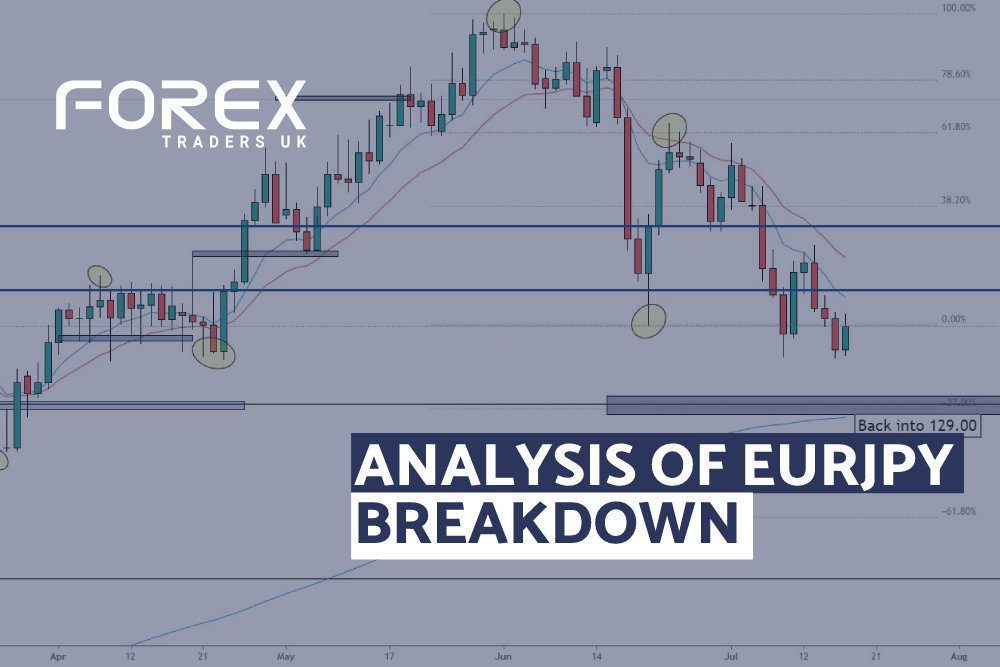
ANALYSIS OF A EURJPY BREAKDOWN

Analysis of a EURJPY Breakdown

Take a look at one of our latest breakdowns on the EURJPY chart as we give Forex traders an insight into our charting tools.

This time, we’ll dissect the EURJPY and look at some of the most recent pieces of analysis that have 90% of the time played out correctly in recent months. We also take a look at the current chart and predict the outcome.

We show you some of the predefined rules we follow and what we allocate ourselves to place into the chart as we look through the different timeframes and analyse the Forex market. As we review the old analysis in our journal, it becomes clear how important it is to save this data in order to learn from it and construct a narrative for future trade setups.

Tools and overall chart structure

The trend formations on the weekly and daily charts have largely determined the overall chart structure we’ve employed in recent months and years. When it comes to being in a Forex trade, we try to keep things neat and establish chart clarity to avoid any confusion. The bias and momentum should be clear, and you should stick to your levels unless any of your key levels break in the wrong direction or to avoid volatile news.

If you have been holding open deals for a long time, news announcements can be detrimental. The volume can create a spike on the chart. As a result, it’s occasionally a smart idea to prepare ahead and close weak positions in advance.

Do you ever feel like you’re lacking in clarity or that you’re losing sight of the broader picture? Then, if there is any mess, it is a good idea to step back to a higher timeframe and tidy up. On the other hand, if you require more information and detail, reduce the timeframe, add more tools, and be creative.

Higher timeframes

We can collect data about larger momentum shifts occurring on higher periods, as we’ve indicated before. In the video, we cover what tools we allow ourselves to use on the monthly and weekly charts, as well as how to build circular levels with clear pricing labels.

We can then use our tools to create confluences in order to establish a broad target and destination. This is the most important part of the trade – the level at which you intend to exit the foreign exchange market.

When we identify these targets, they are usually 75 to 300 pips away, giving us plenty of room to profit from the setup. We can then build upon our other aspects of the trading setup to establish a positive risk to reward ratio.

Lower timeframes

We look for more rapid price swings and construct a plan for where our trading levels will lie on the four hour and one-hour timeframes. By now, you should have your overall targets and destinations set in play.

Thus, it comes down to how precise we can make our entrance in relation to the general trend. On lesser timeframes, we might seek to confirm a setup and trade inside the immediate momentum using trendlines, trendline breakouts, Fibonacci and other breakout patterns.

Share:

Share on facebook Share on whatsapp Share on twitter

4 TIPS ON GETTING A LEVEL 2 FUNDED ACCOUNT

4 Tips on Getting a Level 2 Forex Funded Account

Every prop trader dreams of rising through about climbing the ladder. Learn and use our top 4 techniques for becoming a level-2 funded trader as soon as possible.

Tip #1: Plan, plan and plan

First and foremost, we require a strategy. Make a plan for how you will trade Forex. When it comes to looking for Forex trading setups, what will you look for in the market and how will you maintain your watchlist?

It all comes down to your plan and how well you can stick to it over a large sample of trades to determine if you will succeed as a funded Forex trader. In today’s market circumstances, being a profitable Forex trader is challenging, but having a well-structured plan and an investor will increase your chances of success.

It’s a good idea to brainstorm winning trading strategies on paper or in a folder on your computer. This will serve as your trading bible and a resource for learning how to trade. Revisit it on a regular basis and trade within the parameters of your strategy and pre-trade notes.

When it comes to maintaining your Forex funded account, having a method in place may help you prevent misunderstanding and overtrading. So there are no surprises, you’ll already know what to do and when to do it.

Once you’ve figured out your trading strategy, get to work. Maintain a regular routine in which you are comfortable and follow your success recipe. As you progress through the stages and assume greater responsibility, your strategy should be amended and updated on a regular basis to help you become a better Forex trader.

Tip #2: Frequency trading

As a Forex trader, you should categorize the various types of trades you are prepared to make and have a set percentage frequency for when you would enter each position. A trade setup with five target confluences, for example, will have a greater percentage spot than a setup with two confluences.

As a result, those five confluences may lead you to trade them 80% of the time you see them, and leave them 20% of the time. There are numerous strategies to strike a balance between your trading frequency and the trades you choose to enter.

Because you must consider your maximum drawdown, you must trade with minimal variance and limit the range of trades you open, especially if you’re just starting off with your trading account or if you’re in a drawdown. It is difficult to build long-term habits, because inherently we all want to win as quickly as possible. Maintaining a calm demeanour and trusting the process will result in a less stressful experience with a higher chance of success.

Tip #3: Break down targets into steps

A 10% success rate for a low-risk program is your target. So, by dividing that target into small steps, you can map out which trades you will execute. We have seen that several Forex traders will begin trading without any apparent guidance. When you combine this naivety with a lack of patience, you will find yourself chasing a goal too quickly, which will deplete your skill and force you to rely on luck.

As you progress through the ranks and levels, you will realize how important it is to establish that initial buffer, which provides you some breathing room. Increase the amount of capital away from the drawdown limit by generating a couple of percentages on your Forex funded account. As your equity increases, you will be able to trade with a larger sample size of trades, which will be increasingly dependent on your trading expertise over a longer period of time.

We have set our standard account capital increment milestones, but establishing your own milestones along the route is an excellent approach to break down the procedure and make it more manageable. We can recognise several trends in the variations in traders’ Forex funded accounts at various stages, such as how beneficial it is to construct a large number of modest profits rather than striving for a single home run trade.

Tip #4: Be strict

Maintain self-control and self-discipline. Sticking to a sound trading plan allows you to maintain control over your trades and establish a winning performance. All of the hard effort that goes into getting to level 2 boils down to meticulous planning. Know when to trade, and know when to sit on your hands.

Keep in mind that not every day must be a trading day. Locate your setups precisely and act on the high-probability trades that satisfy your criteria. If a trade doesn’t meet your requirements, don’t try to force it. You, not the market, are in charge of your account.

When you become strict with yourself, the Forex market will eventually reward you for all of your hard work and efforts. If you think of your Forex trades as bricks and continue to lay them in accordance with the plan, the overall structure will endure and you will be able to create something substantial.

The same may be said about your Forex trading. Be strict and stick to your own set of rules. You are your own boss.

Share:

Share on facebook Share on whatsapp Share on twitter

CHART BREAKDOWNS

How to analyse a strong Forex chart breakdown

Use a top-down strategy for a thorough Forex chart breakdown, beginning with a monthly chart and plotting support and resistance levels, then moving down to acquire more detailed recent information on a currency pair.

While there are various trading methods and ways to break down a chart, we have discovered that starting with the higher timeframes is the best approach. When undertaking a top-down study, we normally start on a monthly chart. This enables us to search for overall momentum and larger trends that have developed over the last few months or years.

To begin, we plot two to three key levels at the immediate support and resistance levels. Make sure to round these levels to the nearest level or half-level and mark them as monthly support or resistance, depending on where they are in relation to the current market price. This guarantees that the levels are psychologically attractive to the currency pair.

Most Forex traders will also put their stops at these round levels. You’ll have a precise trading aim in mind, knowing exactly where the levels are and how the market is moving.

Move to the weekly Forex chart

Then we go down to the weekly to acquire more up-to-date information on the currency pair’s performance. Even on a weekly basis, candlesticks have a lot of weight when it comes to predicting future results. Weekly candlesticks may carry a lot of momentum and move a currency pair a number of pips, so it’s crucial to look at the latest 5 to 20 candlesticks and see how they played out.

We can allocate up to two more key levels throughout this timeframe; be sure to round these levels to keep them clean, and identify them as weekly levels for future reference. This will help you distinguish the levels and comprehend their impact on the lesser timeframes as you step down the timeframes.

The more organized and tidy the chart is, the easier it will be to traverse, and you won’t have to undertake another thorough top-down analysis for weeks or months, depending on the quality of your analysis. As you gain more chart time and experience, you will notice that you are not rebuilding your analysis as frequently as you once were, owing to the market repeatedly using your key levels.

Step down to the daily Forex chart

We may then move down to the daily chart to see more detail about where a currency pair might be headed in the next one to four weeks.

On the daily chart, we can assign up to two more critical level zones, which will be labelled as daily. In order to trade within the overall direction of the chart, we should also search for Fibonacci movements within the trend and extension possibilities between the retracement and goal levels. Look for trendline bounces and breaks as well, as the daily can offer some excellent setups.

On the daily and weekly timeframes, you should be able to recognize the overall trend and set one or two strong targets, as these are the import destinations where we believe the market will end up. The most critical aspect of a currency trade is the destination; otherwise, you will have no idea or strategy for exiting positions.

Find setups on the 4-Hour Forex chart

Finally, we reach the 4-Hour Forex chart. Some traders might want to also utilise the 2-Hour Forex chart and 1-Hour chart. We recommend traders not to go below the 1-Hour timeframe as this can increase chances of profitability and not result in a charting mess.

We want to try to discover our entry point into the Forex market as we continue to analyse the 4-Hour Forex chart. Using more trendlines and breakout ideas, momentum should begin to build in regions where we can discover strong risk-to-reward trades that we can trade towards our overall targets found on higher timeframes.

You will also need to think about allocating a stop loss in a safe place where you believe your bias will change. If the Forex market does go against your bias and it reaches your stop loss, then the market will likely continue in that direction and your trade will be stopped out.

You may be exposed to contradicting information as you progress through the different timeframes, which can be confusing to a trader. Always consider the higher timeframe as more solid information because the movements will be more reliable than shorter-term chaotic swings. If you’re ever confused or need more clarity, go back to a longer time frame to gain a better image.

To get your head straight, you might want to delete some of the analysis tools. On the other hand, if you need require more information or a more precise structure, you should certainly reduce the period. Learning the best strategies for scaling timeframes takes time, and each Forex trader has their own method.

Share:

Share on facebook Share on whatsapp Share on twitter

BASIC CHART PATTERNS

Basic charting patterns explained

Using established chart patterns can help a Forex trader spot more opportunities within the market. Our experts explain how you can utilise chart patterns optimally.

Using established trading patterns can help a trader to spot more opportunities in the Forex market. However, spotting a single chart pattern on the daily chart isn’t a winning formula. It is about how we use chart patterns in combination with other tools to create more confluences which will inevitably give our setups more probability.

Employing chart patterns will be similar to using a bomb detector in that you will be able to locate moments on the chart before the explosion of movement. If you can correctly detect a breakout explosion, you’ll often be able to win handsomely in that trading spot.

As well as showing areas of fast movements approaching, chart patterns can offer indications of great trades around entry points. Let’s cover some of the basic, classic charting patterns.

While some chart patterns, such as triangle formations, are not included in this article, most other classic chart patterns will provide more complex signals for finding trades. You will quickly obtain a lot of chart experience if you understand the fundamental concepts and keep your chart clean of overcrowding indicators.

Keep in mind that many other Forex traders will be attempting to use these tools as well, so be on the lookout for market manipulation. Make sure you note your entry and exit levels before allowing the action to unfold.

Wedge patterns

The wedge pattern in technical analysis is made up of two trendlines. We can break the wedge pattern into two forms – a falling wedge and a rising wedge. They tend to operate in different trends.

The main characteristic of these chart patterns is that they pull price action together like a spring, and the market prepares to release the spring, resulting in a decent breakout movement.

Rising wedge

Within two trendlines, a rising wedge is formed during a period of consolidation in an uptrend. It is frequently associated with price action that is steep. The lows are frequently printed faster than the highs, resulting in a wedge shape pattern. They can appear at any point during the course of a trend.

Price will frequently break out to the upside at the start of a trend, and it may also break out to the downside at the end of a trend. To create a target using the rising wedge, measure the base height and add it to the breakout to get the target level, which we can then trade toward.

Because these patterns aren’t as straightforward to draw on the chart, you’ll need to be inventive when employing them. When you’re in a profitable trade, lock in profits as soon as possible to help this charting pattern become even more profitable.

Falling wedge

The falling wedge, like the rising wedge, provides trading possibilities in the opposite direction. They can be discovered in a downtrend with price action that is dense. To create a target using a falling wedge, measure the base height and add it to the breakout height to get the target level, which we can then trade towards.

Rectangle break out patterns

Rectangle breakouts appear to be more common, and they’re the most popular method to view a breakout from a key level. On their charts, a competent trader will draw rectangles to represent support, resistance, or targets. We can search for momentum breakouts to carry our trades to the next target level when the price fluctuates between these levels and revisits them often.

These chart patterns are simple to draw and provide consistent movement as long as you trade with momentum and within a trend. To determine this, look to the left for a succession of higher highs or lower lows. You will come across manipulation that can lead to false breakouts from time to time, but understanding the overall sentiment and keeping to your original bias will help.

Head and shoulders pattern

Because it entails a trend change, the head and shoulders pattern is less prevalent. Because finding one at the end of a downturn would be deemed an upside-down head and shoulders pattern, it is most often during uptrends or at the end of uptrends.

As shown in the video above, the peaks will determine the formation. We need to see a left peak (left shoulder), followed by a higher peak or higher high (head), followed by a lower peak or lower high (right shoulder), and then a break and closure below the base neckline. Once we get this classic formation we can then look to short or sell that currency pair.

Depending on the preceding price action and what levels of support it lines up with, the target is then measured from the head or right shoulder. Some traders may wish to keep the trade open for a longer period of time because the trend on a higher timeframe has recently changed and there is much more potential. We recommend closing all, or at least a large portion, of the profit at the target as we don’t want to be too greedy or become overconfident when trading this chart pattern.

The head and shoulders pattern can appear on a variety of timeframes, from monthly to daily. While you might be able to locate one on a smaller timeframe, we’ve found that it’s not as reliable, therefore we recommend sticking to the daily or weekly timeframes to uncover these types of trend reversal patterns.


Share:

Share on facebook Share on whatsapp Share on twitter

LEVERAGE TRAPS IN FOREX

Leverage traps in Forex

High leverage and a lack of risk management discipline are the two main killers for rookie Forex traders. If effective risk management is not implemented, this might result in significant losses.

In Forex, leverage is comparable to margins, but not identical. The number of times you can leverage your entire quantity of capital is referred to as leverage. The maximum trading leverage will then be determined by the margin requirement.

Almost every new trader will fall for the leverage trap when they enter the Forex market. They see a 1:500 account with a minimum £50 deposit and think they can use their account repeatedly because that’s what the data on their compound Excel spreadsheet indicates.

If you don’t have much experience in the Forex market, even starting with a few thousand dollars can be a bad choice. If you are a novice trader, we recommend that you begin with a demo account to gain a better understanding of how the market operates before plunging in with both feet.


Don’t be fooled by manipulated scenarios

It’s common knowledge that most brokers will manipulate situations for a profit. With 90%+ of Forex traders losing, the broker can offer accounts that build upon their success and not the success of traders. They do this by controlling the spreads, leverage, and other factors that can be adjusted in trading scenarios.

Set trading guidelines for yourself before deciding which trading account to open, and stick to them with a low-risk strategy that focuses on long-term growth. You may be thrilled about increasing your competence and winning over a wide sample of trades without having any short-term emotion linked, but you must set realistic expectations for yourself and choose a reasonable leverage option.

Leverage and margin

If you are unfamiliar with margin in trading, check out our recent blog covering the basics. Leverage is essentially managing or trading a large amount of capital using a much smaller amount. The remainder is then borrowed to control more capital.

If you have £1,000 in a trading account with 1:100 leverage, then you will control £100,000 with £1,000. If the leverage was 1:1, you would control £1,000. Now it may seem like you should apply as much leverage to your account as possible, but placing a large position on a £1,000 with 1:100 is almost certain to end in a loss or blown account.

We have seen authorities step in over the years to bring down the maximum in certain regions and situations. We have also seen brokers offering 1:2000 leverage with a £10 deposit. While leverage is beneficial, too much of it, especially combined with poor risk management, may be disastrous.

How to use it?

As a beginning trader, using lower leverage is a terrific approach to get your feet wet and increase your account. As previously stated, there are numerous drawbacks to trading with high leverage. It will eventually enable you to increase the size of both your successful and lost transactions. But keeping a controlled 1:5 to 1:30 leverage is ideal for growing any amount of capital over a long and sustained period.

As mentioned in previous blog posts, we need to stay away from margin calls. We do this by making sure our risk management is perfected and we allow ourselves to survive any losing streaks to hopefully come out on top.


Consider the correct amount of leverage

When opening a Forex account, you should decide on the appropriate level of leverage after considering the associated fees. When you utilize large quantities of money, transaction fees can rise, but you also want to leave room for rewards.

The higher the leverage, the higher the commissions and swaps on your trades. It is possible that transaction costs can hinder your success if your leverage is too high, not to mention destroying your ability to trade much large lot sizes.


Survival with a decent trading plan

With a sound trading plan and a modest leverage account, you can survive, but as you get more charting experience and a better understanding of the markets, it’s a good idea to gradually increase the leverage while still adhering to good risk-management principles.

All these factors depend on the trader’s style and situation. For example, if a trader places mostly swing positions with a high pip stop loss, then an increase is not necessary. But for day traders who operate with 15-50 pip stop losses, leverage will be used more naturally. So many factors are used to determine the correct amount of leverage.

Conclusion

The moral of the story is that leverage should never be underestimated. Make use of it to increase your capital and your success. It’s a powerful instrument that can either help or hurt traders. Never trade with a short-term attitude and always strive to improve your skill set. With low leverage, you can trade safely and protect your capital. Be honest with yourself about your goals and treat the market with respect.

Share:

Share on facebook Share on whatsapp Share on twitter